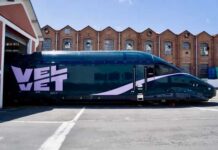




















The number of railway lines continues to grow in Europe, including over long distances. And not always on high-speed trains. For example, on 1er May 2026 a direct service between Copenhagen and Prague via Berlin following an agreement between Danish Railways (DSB), Deutsche Bahn (DB) and Czech Railways (CD). Operated daily during the day in each direction by the Czech Comforjet train, with a capacity of 555 passengers, the journey should take 7 hours between the Danish and German capitals, with stops in Hamburg and Dresden, and 11 hours for the entire route, from Copenhagen to Prague. Given this length of time, these trains will be equipped with wifi for work or relaxation, and above all a dining car for lunch or dinner. They will also have special services for people with reduced mobility and spaces for bicycles.
Europe supports the development of 10 cross-border lines
This long-distance Copenhagen-Berlin-Prague line, as well as the future Munich-Milan-Rome link, are supported by the European Commission, as part of the Connecting Europe by train" programme. Launched in 2023, the project aims to create ten international routes to encourage more environmentally-friendly mobility. Some routes are already in place, such as the Paris-Berlin service operated by DB and SNCF launched last December or the Warsaw-Split line, operated since June by Polish Railways (PKP).
At the same time, the EU intends to promote high-speed rail by 2040, a network linking the capitals of the member countries of the European Union. These new conventional lines - day or night - or high-speed lines should support the growth of new booking platforms that have already signed distribution agreements with European rail companies, with Trainline leading the way in the French market. Members of the European Parliament are campaigning for the creation of a global booking platform that would enable passengers to buy tickets from all European companies.