


















With 86.4 million passengers recorded at its airports, Air traffic in metropolitan and overseas France fell by 0.8% in the first half of 2026. The decline is accelerating as a result of the war in the Gulf: a fall of 1.9% in passenger numbers in June, following a fall of 1.3% in May, 3.2% in April and an increase of 1.4% in March.
All routes showed a decline except for three sectors: domestic radial routes, which recorded a total of 5.8 million passenger journeys between January and June. This represents growth of 3%. It would appear that Transavia is indeed having a positive impact on the main routes linking Paris to the major regional cities. Over the first six months, the Paris–Nice route grew by 5.51 per cent quarter-on-quarter and the Paris–Toulouse route by 7.11 per cent quarter-on-quarter.
‘Françafrique’ is also very much alive – at least as far as air travel is concerned. Between January and June, passenger numbers there rose by 4.2%, totalling 12.7 million travellers. Finally, the last segment to show an increase of 4.5% between January and June was international routes from the overseas territories, totalling 1.3 million passengers.
International markets hit by the Gulf War and a loss of affection for the United States
Conversely, total passenger numbers across all international routes fell slightly, from 0.6% to 73.5 million. Unsurprisingly, the sharpest decline was in traffic on the Asia-Pacific route network, down by 8.9%. This is mainly because it includes traffic to the Gulf states. Admittedly, the DGAC does not provide figures by sub-region in its bulletin. However, it reports that traffic between France and the United Arab Emirates fell by 25.5% between January and June. The rest of Asia, by contrast, showed an increase, ranging from around 4% to 5%.
Traffic to the Americas fell by 0.5% in terms of cumulative passenger numbers over the first six months. It is worth noting that the World Cup, which began in June, did not really result in a surge in traffic with the United States, which fell by 3.7% in June and by 2.9% since the start of the year. Conversely, as a knock-on effect, traffic with Canada has risen sharply over the first six months: an increase of 6.6% in passenger numbers. There was also a rise in traffic in June, albeit a more modest one at 1.9%.
Passenger traffic with Europe has also fallen slightly. With 34.7 million passengers within the EU, this traffic fell by 0.8% in the first half of 2026 compared with 2025. Outside the EU, traffic to Europe has been hit harder: it fell by 1.4%, a decline driven in particular by the slump in traffic to Turkey – down by 9% – due to the Gulf War.
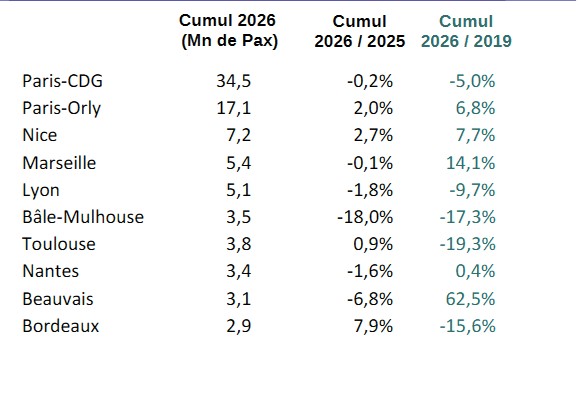
As for airports, four of the ten largest have seen a fall in passenger numbers. The sharpest decline in the first half of the year was at Basel-Mulhouse Airport, where renovation work on the main runway lasting nearly a quarter led to an 18% drop in traffic. Beauvais is also in a difficult position, with a fall of nearly 7% in total passenger numbers, due to Ryanair’s withdrawal following the rise in air passenger duty in France.
On the other hand, there is good news for airports in the south-west: Bordeaux and Toulouse are finally bouncing back after several years of decline. The Gironde airport recorded passenger growth of 7.9% in the first half of the year, whilst Toulouse saw an improvement of 0.9%. As for Paris, whilst CDG has stagnated (-0.2% over six months), Orly has seen growth of 2% over the first six months…