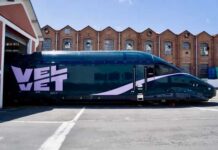


















Brightline at Florida has been the leading private rail operator in the United States for 40 years. The young rail company aims to extend its network, which currently includes a line linking Miami to West Palm Beach via Fort Lauderdale. On this 105 km long line, 17 trains run daily for a journey time of one hour and 10 minutes. The slow speed of the trains (125 km/h) is due to the fact that Brightline shares the use of the railway tracks with a freight operator.
But the future is full of promise. Visit 2022Brightline trains will arrive at Orlando with service to theinternational airport. On the 250 km section, trains will reach a speed of 175 km/hand even 205 km/h over the last 50 km. The journey between Miami and Orlando International will take 2 hours 45 minutes. The train station will be directly linked to Terminal C of the airport by a pedestrian bridge.
In a later phase, a 135 km section should enable trains to reach Tampa at 205 km/h with a stop at Disneyland. Brightline estimates the potential for over three million passengers on Miami-Orlando. By 2019, the line will have carried just under 900,000 people to Miami-West Palm Beach.
The United States resists the wave of high-speed trains
The Nevertheless, the United States remains the only major developed country in the world without a genuine high-speed network.. L'ACELA Expresswhich links Washington to Boston via New York and Philadelphiafor example, drives 120 km/h on average. Only one section of around fifty km allows trains to reach 240 km/h. A strange situation that can certainly be explained by the powerful lobbies of the construction industry and the airlines.
The railway company Amtrak recently presented its plan to modernise its lines. An 80-billion-dollar plan reserved mainly for the renovation and doubling of track. While the TGV network will not be expanded, new trains will improve average speeds, particularly in the loops. Two high-speed lines in California (Los Angeles-San Francisco) and the Midwest (Chicago-Springfield-St Louis).
Visit CaliforniaA first section of 273 km between Bakersfield and Merced via Freno is currently under construction. At Merced, trains could in future run to San Francisco and San Jose. If an environmental impact study authorises a tunnel. From Merced, the line would run to Sacramento, the Californian capital. And from Bakersfield to Burbank. Here too, the authorities are assessing the environmental impact of the line.
In the MidwestThere is also a project linking Chicago to St Louis via Springfieldthe capital of Illinois. Trains cover the 480 km between the two cities in 5.5 hours. The TGV project is estimated to cost 40 billion dollars, but could reduce the journey time to just under two hours...