








What are the issues specific to rail transport?
Julien d'Hoker - We need to know what passengers expect now and in the future. In particular, we are studying social trends such as the dematerialisation. The big news is that each passenger now embarks with their own technology. Increasingly less passive on the train, customers are not just travelling. They work, play, rest and eat. Environments are therefore approached in the form of themes, with a variety of design responses to suit these different moments.
Any examples?
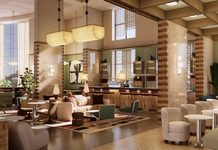
Julien d'Hoker - Traditional square, duo or solo seats, which can be oriented to face the windows so that passengers can enjoy the scenery they are travelling through. For thebusiness worldthey are small officesThe use of high tables and chairs to create a homely atmosphere. The use of high tables and chairs to create a typical working atmosphere. coworking is also in the pipeline. The trend is to bring the city onto the train so that everyone can get on with their day's activities. Experiments are being carried out in Germany by the DB, in Switzerland and in France.
there are plans for passengers to travel in a position between sitting and standing
What are the innovations in seating?
Julien d'Hoker - For the train, the seat evolves in its modularityfor example, by offering the possibility of carrying out a rotation to travel in the direction of travel. The ergonomics of the seat, its inclination, the headrest and the equipment on offer such as electrical sockets and reading lights should make the journey more comfortable. maximum comfort. The architecture of the seat can also vary, with bench seats to share the pleasure of the journey. Finally, with a view to increasing capacity, there are plans to have passengers travel in a position between sitting and standing.
What role do new technologies play?
Julien d'Hoker - It's important, of course, but the new technologies sometimes discreetly to adapt to passengers' needs. They create new uses on the train. In particular, it is possible tointegrating screens into so-called "intelligent" windows which can be used to provide information and entertainment. An experiment is being carried out with this in mind on the Orlyval. We can also start with a train that is as neutral as possible, but that will offer different atmospheres on the outward and return journeys or in each car, through a set of lights and video projections on the walls. What's more, the work on acoustics will make it possible to reduce the sounds in a car in order to create a hushed atmosphere conducive to work or, on the contrary, to increase them in spaces of social exchange.