


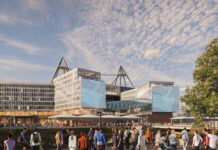
















The face of London has been radically transformed for some time now. The 2012 Olympic Games brought with them a host of new totems: Anish Kapoor's The Orbit, a 115-metre-high red and metallic serpentine; Zaha Hadid's very feminine London Aquatics Centre, with its elegant curves; and Renzo Piano's Shard, an angular shard of glass towering 310 metres above the City. A profusion of new emblems, then, but also a profusion of building sites and cranes that still pierce the skyline today. Because London, more than ever, is nurturing major projects, such as Crossrail 1, an express network of some forty stations on which work began in 2009 and which should link East and West London over more than 100 kilometres by 2018. Cost of the project: £15 billion, or more than €20 million. The next stage is Crossrail 2, its North-South counterpart, scheduled for 2030. But that's not all. There is also the high-speed rail link between London and Manchester, the first section of which will open in 2016 at a cost of over £40 billion.
In terms of architecture, things are also changing, with a concept that is already flourishing in London: revitalisation. "In this respect, the Olympic Games were very important. They were the pretext for the creation of an urban legacyexplains Barbara Jamison, Director of Business Development Europe at London & Partners. They have helped to develop and regenerate deprived areas such as Tower Hamlet and Hackney in East London. Among other things, the Olympic facilities are being transformed into office space and business premises."For local authorities, London's 33 boroughs are now part of a whole in which each element must assert its own existence and uniqueness. "Before the Olympic Games, London was seen above all as a city of finance. Today, priorities have changed. Other sectors are emerging, sport of course, but also technology, health, science..."says Barbara Jamison.


Pink Floyd and Norman Foster
Among the neighbourhoods set to be given a new lease of life is Wandsworth, to the south-west, with Battersea Power Station, the legendary former power station with its four white chimneys featured on the cover of Pink Floyd's 1977 album Animals. The 16-hectare site, which will soon be served by a new Northern Line metro station, will include housing, commercial spaces, offices and parks. The Malaysian consortium at the head of this vast £8 billion programme has even invited a few architectural stars such as Norman Foster and Frank Gehry. "What's surprising is that people are still building in the heart of London. But it's such a big city - about 15 times bigger than Paris - that there's still plenty of space to convert, explains Florence Gomez, Director General of the British French Chamber of Commerce. At Earl's Court, to the south-west of the centre, the former exhibition centre is also to be converted to accommodate a residential, cultural and commercial project, again at a cost of eight billion pounds.." Work began in 2013 and is not due to be completed until 2033, with several phases of opening. "In all, there will be 7,500 homes, as well as the creation of a new 'high street' along the lines of major London thoroughfares such as Regent and Oxford Street. There will also be schools, areas dedicated to sport and culture, gardens, etc."says Florence Gomez.

While many regeneration areas are mixed-use, Shoreditch in East London is focused on a very specific area of activity: high technology. Long home to British Telecom, Shoreditch has developed almost organically around information technology, encouraged by the government's Tech City initiative, launched in 2010. Thanks to the opening of High Street Rail Station shortly before the Olympic Games, the area is better connected to the rest of the city and has attracted start-ups and incubators. There were 200 in 2010. Today there are more than 2,000 of them, operating between fashion boutiques and bohemian-chic cafés.
"At the moment, the software and ICT sector is one of the most profitable. Since 2013, it has accounted for around 10 % of UK GDP, and double-digit annual growth is expected for several years.It's a great place to do business," says Hervé Grella, Communications and Marketing Director at UK Trade & Investment, the agency that helps foreign companies set up in the UK. London is now Europe's biggest technology cluster, the latest meeting place for start-ups, coworking spaces and Internet giants such as Google, Facebook and Twitter. "While the finance sector is in the process of taking off again and returning to performances close to those of 2008, London is undergoing profound structural changes. The dynamism is palpable, and not just in the City"says Hervé Grella.

The new voice of King's Cross
As part of this positive energy, the King's Cross district, not far from Shoreditch and Saint Pancras station, is becoming a focal point for technology, scientific research and creativity. The regeneration of the area began in 2005, thanks to the £500 million allocated to the renovation of King's Cross station, which serves England's east coast. This conservation work has been awarded a European Union Cultural Heritage Prize. The 27 hectares of this post-industrial site have begun to be repopulated thanks to universities such as the Central Saint Martins art school and the Crick Centre biomedical research centre. The Alan Turing Institute, which specialises in computer data, is due to open soon.


Google takes up residence
The streets of this 'Knowledge Quarter', still under construction, are slowly coming to life. Every day, stylish students and busy professionals rush into the new underground station, which looks very much like 2001: A Space Odyssey. Others stroll around the newly-developed Regent Canal, or pick up a Korean burrito from one of the food trucks lined up opposite a former coal depot. But the real revolution in King's Cross will come in 2016, when Google moves its European HQ into a £650 million building. "It's a major investment, because we want to become increasingly involved in the UK, where the first computers were born and the web was invented."said Matt Brittin, Vice President Northern Europe for the American giant.

London's tremendous dynamism is making foreign companies salivate. "There is a favourable tax policy here for businesses. The level of tax, which has been around 25 % in recent years, has fallen to 21 % and is set to fall further to 20 %, compared with 33 % in France."says the Director of the French Chamber of Commerce. What's more, the unemployment rate of around 6 % is also an attractive factor. However, it should be noted that people employed part-time or even for a few hours a month are considered to be economically active, which is why the unemployment rate in Great Britain has fallen sharply. Nevertheless, the French are setting up shop and investing. In fact, France is the leading European investor in the UK and the third largest in the world. It is even said that more than 200,000 French people live in London... Question: qualitatively, do they live better or worse than in Paris?
Special report - London: let's swing again!
- London: the future is now!
Success story London - Meeting with Francesca Rosella
Success story London: meet Katy Turner
The mad French influx to London
Contemporary art: London steals the show from New York and Paris
Hotels in London: the race for the stars
London's top table
Success story London - Meet Simon Rogan
The spirit of London according to Libby Sellers
London: address book
