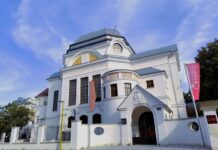
Towering ferns climb to the ceiling, Jacques Gruber's stained-glass windows display pine branches and ginkgo biloba leaves, not to mention Louis Majorelle's mahogany furniture and Daum's large wrought-iron chandeliers, studded with glass paste and diffusing a soft light... What better way to start than with the perfectly preserved décor of the Excelsior brasserie, a jewel of the École de Nancy? What could be more surprising for a corporate group than breakfast or lunch in this temple to nature? Florence Dossmann, Head of Communications at the Tourist Office, explains: "The history of this school began when Alsace and part of Lorraine were annexed by the Prussians in 1871. After the loss of Metz and Strasbourg, Nancy remained the only major French city in the east. The inhabitants of the annexed territories emigrated and many settled here, before eventually returning to Paris. As a result, the city's population doubled in around forty years. With this tremendous economic development, industrialists and shopkeepers expressed their desire to live in a new, fashionable environment. The designers and craftsmen of Lorraine were to offer them architecture, furniture and decorative objects inspired by nature; an artistic movement common to the whole of Europe known as Art Nouveau.


A flourishing school
Throughout the centre of Nancy, small groups of visitors can discover these witnesses to a happy era. It starts with the house of the printer Albert Bergeret - a successful publisher of illustrated postcards - which houses ironwork by Louis Majorelle, a magnificent stained glass window by Jacques Gruber, Rose et mouettes, a fireplace by Eugène Vallin and paintings by Victor Prouvé. Another house with the "Nancy SchoolLouis Majorelle, built by architect Henri Sauvage, with highlights including a fireplace and terrace railing in flamed sandstone by Alexandre Bigot, stained glass windows by Gruber and furniture designed by the owner.
During a rally, you can follow in the footsteps of this abundant style from stage to stage. Like this surprising stop at a Crédit Lyonnais branch on rue Saint-Georges to see the huge glass roof of the hall with a frieze of clematis, the work of Gruber. Or in the Ginkgo pharmacy, where the leaf of the ginkgo biloba tree has been applied to the wooden furniture, the mosaic floor and even the nameplates on the doors. The stone algae in the Weissenburger house, the wrought-iron umbels on the gates of the Georges Biet building, and the huge poppy flowers on the ironwork of the former Génin grain factory are also surprising. Even at meetings at the Chamber of Commerce and Industry, participants can let their minds wander for a few moments while admiring other stained glass windows by Jacques Gruber.

Art Nouveau, even if it doesn't say so explicitly, was inspired by the eighteenth-century style, which it digested and reinterpreted with a certain idea of earthly paradise, taming the petals of the flowers it used as models - the Pope's coin, for example, but also the umbel of the Giant Hogweed or the thistle, the former emblem of the Dukes of Lorraine. In Nancy, the eighteenth-century style is at its most exuberant in Place Stanislas, a royal agora in homage to Louis XV, designed by Stanislas Leszczynski, the former King of Poland who became Duke of Lorraine, and his architect Emmanuel Héré.
Ex-King and bon vivant
A meeting place for all the people of Nancy, in fine weather it takes on the air of an Italian piazza, with its terraces stretching out in front of the classical buildings. Between them, the red thread is a string of railings, a masterpiece of the wrought-iron locksmith Jean Lamour, who used his excellent skills to create wrought-iron arabesques enhanced with gold leaf. Marianne Valois, tour guide, explains: "Historically, Stanislas lost his kingdom of Poland in 1736. The problem was that he was the father of Marie Leszczynska, the wife of Louis XV. The King of France, through international negotiations, advised Duke François-Étienne of Lorraine to marry Empress Marie-Thérèse of Austria, with whom he would have sixteen children, including Marie-Antoinette. Louis XV then gave his father-in-law the duchy, which was to become part of France on his death. Louis XV thought he had done a good job, given Stanislas's advanced age. But the ex-king, who was very much alive, did not die until 1766, at the age of 88. That's why, in 2016, Nancy is celebrating the 250th anniversary of Lorraine's reunion with the kingdom of France.


After stopping in the square for a traditional coffee break, groups can take part in an event organised to mark the anniversary. The exhibition "Lorraine on the horizonThe "Duchy of Lorraine and France" exhibition provides an insight into the relationship between the Duchy and France over the years. But there are other, more regular events to keep tourists coming back to the town, such as the video projection show "See you at Place Stanislas". which illuminates the facades, followed in October by an ephemeral garden, this year on the theme of "The Garden".Stan, royal gardener. From the end of November to the beginning of January, the Saint-Nicolas festivities take place, with a village of chalets selling gingerbread and other specialities such as macaroons and bergamots, concerts, parades and street shows.

Mathias Lucien Rapeaud, Managing Director of Nancy Tourisme et Événements, explains: "Nancy is a little Paris. It has an Italian-style opera house, a ballet company, three outstanding gardens and three UNESCO-listed squares. There's a real cultural force here... For example, for small groups, our office can organise aperitif or unusual tours, combining discovery of a place rarely open to the public - backstage at the opera, ballet rehearsals, the terrace of the Héré arch, the Craffe gate, the Stanislas library or even a convivial tasting of a Toul wine. We also have a marina where groups can take a boat trip, lunch or dinner on a barge. He added "Almost anything is possible! The diversity of our activities means we can meet most of the expectations of professionals. We can offer golf, rowing and even cycle touring on the Moselle loop... Of course, we also cater for 'fashionable' requests such as cookery courses, taking a ride in a gyro-pod in the Haye forest, or go-karting! Not forgetting the Villa Majorelle, which is soon to be restored.
New techniques
On Place Stanislas, the Musée des Beaux-Arts also houses some fine references to Art Nouveau. Michèle Thisse, communications officer, explains: "The museum has a number of paintings, including those by Victor Prouvé, which glorify the family and republican values, and those by Émile Friant, which depict scenes of ordinary life with a photographer's eye. In the basement, we displayed our collection of Daum glassware. Jean Daum, a notary in Bitche, moved to Nancy after the 1870 war, and then bought a glassworks that was popular with the bourgeoisie of the time. His son Auguste continued his father's work while improving techniques and details, and his brother Antonin, an engineer who had graduated from the Centrale engineering school, experimented with the properties of acid and added more colour thanks to the collaboration of glassmakers and decorators. This new artistic breath gave rise to some remarkable collections. Daum was present at the World's Fairs and the company was recognised throughout the world.


At the same time, other artists such as Émile Gallé, who ran a crystal and ceramics business, were testing new techniques to create shapes inspired by flora. Many of his glassworks can be found in the Musée de l'École de Nancy, a place to discover as a group, with a garden featuring an astonishing aquarium pavilion topped by a glass umbrella. Véronique Beaudouin, head of communications, says: "The Musée de l'École de Nancy opened in 1964 in the country house of Eugène Corbin, founder of Magasins Réunis. Criticism was rife. What was the point of reviving this rather heavy, overblown style? A journalist from Le Figaro even questioned the appropriateness of a museum devoted to 'nightmare art'. Yet it contains some treasures, including Charles Masson's dining room, designed by Eugène Vallin with paintings by Victor Prouvé. Other highlights include Émile Gallé's water lily desk, Louis Majorelle's bedroom, Daum's glassware and Gruber's stained glass windows.
After this total immersion in this plant world, fantasised by avant-garde designers, it's back to the history of the region. About thirty kilometres from Nancy, in Lunéville, groups can discover the château, nicknamed the little Versailles of Lorraine or the château des Lumières. This building, the residence of the Dukes of Lorraine, was enlarged and embellished by Stanislas Leszczynski, but suffered a devastating fire in 2003. Since then, it has become a venue for temporary exhibitions and walks between the French garden and the Bosquets park, where, as all these artists have so skilfully expressed, nature has always been able to reclaim all its rights.