Report Serge Barret / Photos Alain Parinet
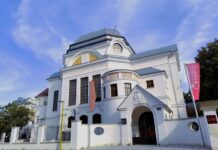
The result is mouldings and garlands, pilasters and fluting; it's full of flowers of paradise and cherubs... It's applied in stucco to the adjoining façades of houses perched high above the ground, like an echo of the pastries that the 19th century was so fond of.e It's the perfect place to start a new chapter in the western world, with Miami Beach-style colours in every pastel imaginable, from buttercup to pistachio to baby pink. It's lovelyIt was all the more unexpected in Phuket town, the capital of the island of Phuket in south-west Thailand.
This is known as the Sino-Portuguese style. A unique style generated by the bourgeoisie of a large Chinese colony that took over from the occupants of a former Portuguese trading post, a population that settled there at the turn of the 19th century.e Phuket was once an open-pit tin mine. Tin was later replaced by rubber trees and coconuts, all of which made Phuket one of the world's most popular tourist destinations. the richest region from all over Thailand.

Corner of Soy Rommanee Street and Thalang Road, 3pm. In the heart of perfectly restored historic centre since the early 2000s. The heat could easily rival that of the hottest rooms in a Turkish hammam. At the same time, the calm is absolute, the silence almost total, barely disturbed by the presence of a young Thai couple in the middle of a photo shoot. Does this young couple have any idea that they are in what used to be the Rue des Plaisirs?
At the end of a few arcades under which souvenir shops, coffee shops, ice cream parlours and restaurants now line up, the glazed tiles and golden mass of a temple, Wat Putta Mongkon, stand out, the antithesis of the canons of Western religious architecture. Sculptures of white elephants, bright reds - lots of bright reds - altars and mysterious divinities smothered in smoke from incense sticks. There are plenty of temples like this, scattered all over the island's landscape. But for now, the walk continues through this tiny colonial quarterjust a few streets away. It leads to some very rich buildings, almost mansions, one of which houses the Blue Elephant, probably the most famous restaurant in Phuket town.
The building, a sort of exotic mansion that was once the governor's mansion, sits at the end of a grassy esplanade lined with century-old banyan trees. The floor has retained its green and cream tiles, the walls are duck blue, the sofas are rattan and, of course, the ceiling fans are spinning. It's chicOn the first floor, above a monumental black wooden staircase, are the former reception rooms, now used for events for up to 500 people. Above all, the Blue Elephant welcomes groups for Thai cookery classes, with tasting sessions afterwards. Early in the morning, the chef helps participants to get the ingredients they need from the local market, just a two-minute walk away. And this chef is indispensable. The market is, of course, tropical, with everything from mangoes, bananas and pineapples to mysterious herbs and condiments, as well as many other not-so-tasty items, such as dried fish.

As you can see, the old walls of Phuket town only occupy a very small area. So you won't need much more than half a day to explore them, cultural of course. As for the rest, the destination is above all a seaside resort, with sublime beaches, crystal-clear waters and all the entertainment that has attracted international tourists since the early 1980s. Business included. There are 39 islands and islets, most of them uninhabited, scattered across the Andaman Sea off Phuket. Embarkation takes place at the marina, from 7am, to avoid the bulk of the tourists, and the tours are more than a great success. They are mainly bound for two islands made famous by two no less famous films: a James Bond film, The Man with the Golden Gun, starring Roger Moore and Christopher Lee, and closer to home, The Beach, starring Leonardo Di Caprio, Guillaume Canet and Virginie Ledoyen.


Sizzling navigation
The speed boat. A much more sporting experience than you might imagine. Driven by its three 200hp engines, the boat, which carries around thirty people, travels at over 50km/hour over the waves. "It can be up to 80"the skipper boasts. But no thanks! The boat leapt up, fell back in sprays of foam and took off again to face the sea. All of this is accompanied by an infernal noise, that of the engines added to that of the water pounding under the hull... After around thirty minutes of hair-raising sailing, we enter Phang Nga Bay, a landscape unique in the world made up of limestone formations, peaks like nails driven into the sea and covered in vegetation.
This is the case of James Bond's island, which is tiny, very steep and overlooks the highly photogenic rocky peak of Ko Tapu, where the very nasty Scaramanga hid its secret weapon. Although they all appear identical, these rocks are more or less unique. For one, you venture, feet in the water and helmet on your head, into a long gut plunged into the dark and leading to a clearing. An almost perfect circle around fifty metres in diameter, completely enclosed by 250m cliffs. Dirty sand, a few dead trees, puddles and that's about it. The setting is almost eerie, even if it foreshadows a far more idyllic location, the one in the film The Beach.
And then there's another island, with an armada of inflatable kayaks waiting for their passengers, two per boat plus the paddler, for an hour-long trip through the mangroves and the tortured roots of the mangroves. The excursion also includes a visit to a lakeside village on Ko Panyi, nicknamed the gipsy villageinhabited by Muslim fishermen who once came from Indonesia. A real village of 2,000 people. With a bistro, shops, a mosque, a school opening onto the pontoon street, and even... a 16 m x 25 m floating football pitch, originally built for the needs of an advertising film. Very clean alleyways perched on their stilts, big disjointed planks greyed by rainwater, houses that look like they're being pushed, cookers in action on the ground, roosters crowing and cats dozing in flower pots... In the morning, it's all clear... a feeling of absolute calmIt's the kind of place you only find in the far corners of the world's countryside. Like the setting, the atmosphere is fabulous. The filmmakers have made no mistake, using this floating miracle as their field of action.


Finally comes lunch, an unpretentious meal served in a local restaurant set in the middle of a rubber forest. We return at 3pm and relax by the sea, as we need to recuperate from the speedboat adventure. Tomorrow, or rather the day after tomorrow, it's the turn of the second excursion, a real seaside one, to Maya Bay, where the film was shot The Beachabout an hour from Phuket. By speed boat, of course. In terms of the film's setting, there's not much to be seen. The beach is there, hidden at the end of its cove, and so is the tropical vegetation. But as for the totally enclosed lagoon, it's nothing at all, born straight from the filmmaker's imagination. What's more, the 6,000 to 8,000 visitors who used to come here every day are no longer welcome. Too much damage. So we're content with a refreshing snorkelling trip amongst thousands of tropical fish. Fabulous.
Then, after a monkey island - crab-fishing monkeys that swim with the tourists - the excursion makes another stop, this time in a completely different genre, at Loh Dalum Beach. Because the beach, long white beachIt's lined with bistros, restaurants in name only and, above all, discotheques with sandy floors that are completely open to the sea. The Stone Bar, the Ibiza Bar, the Moonlight Bar and the Apache Bar are just some of the places where the youth of the world can enjoy a night of barbaric cocktails. The island is easy to get to, with small ferries docking on the other side. The return trip to the Phi Phi archipelago will also take place at around 3pm, after lunch on an uninhabited island, or even on a dream islet for groups of business tourists. In this case, white tablecloths, seafood and champagne cocktails. Anything is possible. A breathtaking walk through the canopy With its crystal-clear waters, blue lagoons, fine sand and endless skies - in short, all the postcards that make you dream when you're elsewhere in the urban greyness - you'd almost forget that Phuket is also green, very green, and is covered in places by a perfectly preserved primary tropical forest. We're going to discover it straight away, from above, during a breathtaking walk through the canopy.
The Flying Hanuman is undoubtedly one of the finest facilities in South-East Asia. In total respect for nature what's more. There are suspension bridges, footbridges, coping stones, platforms delicately tied around tree trunks, spiral staircases, zip lines - a good fifteen of them, including one 400 m long - and other delights covering more than 80,000 m.2. The whole thing is perfectly connected, so you can play Tarzan non-stop for almost two hours above the canopy. Sometimes at 40 m, and it's 40 m high, without ever setting foot on the ground, or taking the same path twice in a row. Everything is planned. There's even a course for the truly daredevil who, once seated in a bucket seat, hurtles down a sort of suspended rail at breakneck speed, twirling above and between the trees... Centrifugal force means that daredevils sometimes fly horizontally. All the same, everything is duly secured. A host of instructors accompany the groups, helmets are compulsory and harnesses are doubled. As long as you're not too prone to vertigo, the course is à la carte. "From 4 to 80 years old"say the brochures.
That's the primary tropical forest from the air. But to get an idea of what it can be like in the chiaroscuro of its undergrowth, choose an easy thirty-minute walk not far from here along the swift waters of a torrent that gets very angry during the monsoon season. It's a lovely path that smells of humus and weaves its way through creepers to a waterfall marking the end of the journey. All of this is accompanied, especially at the start, by the thunderous background sounds of around thirty gibbons, large monkeys with disproportionate arms that allow them to move elegantly from branch to branch. They are from the Gibbon Rehabilitation Project (GRP), a wildlife rehabilitation centre of mistreated gibbons. It's a real discovery, very much of our time in any case, led by a French volunteer who describes the mistreatment to which some of these animals are subjected: how they are used to seduce tourists and make them pose for photos, how they are drugged and put in cages that are too narrow, and much worse...


Gibbons return to the wild
Some of these residents were so badly beaten in their former lives that they had to have amputations when they arrived. In a lighter vein, she also recounts their way of life, how they started families and stayed together until they died, and what the rehabilitation programme consists of, in particular the way in which they are prepared, for some of them at any rate, to return to life in the wild. There are anecdotes too. Like that of a male who has been released several times and returns again and again, preferring the comfort of his gigantic cage to the horrors of the jungle. And perhaps also to the domestic scenes... As a result, his female has rebuilt her life. There are gibbons, of course. But they're not the only animals under close surveillance, nor are they the only ones to benefit from a special care. protection programme. According to some conservation organisations, elephants are often more than badly treated too. Even if they are very carefully controlled by the official veterinary services. The same goes for their fellow elephants working in the forests. At least, that's what the guides at the Phuket Elephant Sanctuary explain.


A number of business tourism agencies have taken this on board, offering tours of the centre. rather than a pachyderm ride. It's a fascinating half-day discovery, with a video conference explaining the whys and wherefores, followed by a walk, accompanied of course, through the estate where the large animals graze in complete freedom. Bath time is truly magical. After lunch or afternoon tea, as the case may be, it's time to head back to the hotel, its gardens and seaside entertainment, via country roads like those you find just about everywhere in South-East Asia. Electric wires by the dozen, coconut palms, improbable cooking facilities and more coconut treesA temple and a mini-market and coconut palms again, a Thai boxing centre, flashy signs and neon lights... All made from anything and everything, but certainly not made to last.
The design, anarchic to say the least, but not without charm once you get used to it, foreshadows that of Thailand's capital, often proposed as a short, too short, stopover on the way back to Paris. "Groups ask ussays Stephan Pohu, MICE Director at Asiajet. And it's true that on such a far-flung operation, it would be a shame to confine ourselves to a single island and not go on to the next one. at least one day in Bangkok."As a result, you will have to choose between a classic, historic and monumental Bangkok, and another Bangkok, closer to real life, by choosing one or other of its districts, totally away from the major tourist sites, as your base. So, without hesitation, we'll opt for Chinatown. And by bike, no less. It'll fit in with the very contemporary feel of this trip.
A taste of the countryside in Bangkok
On the edge of Chinatown, early in the morning, because the heat can be torrid in the Thai capital. A flat three-hour ride in groups of up to twenty bicycles; a single file winding through another world, a "like before" that sometimes gives way to a "like before". a country village feel. It's not rich, far from it. The houses are shingled and generally covered in rusty sheet metal; the craftsmen hammer at ground level; the improvised canteens set up, as usual, right in the alleyways and the stalls are a joyful mess. It's quiet, the cement of the streets is perfectly polished, there's not a scrap of paper to be seen, and the shrubs that have grown there somehow add to the peaceful atmosphere, a thousand light years away from the ordinary hysteria of Bangkok. Except that, at the end of an alleyway whose narrowness allows only one bicycle to pass at a time, a temple flamboyant in all its reds and golds, the Thian Fan, stands on a large square. A far cry from a bucolic temple.


Better still, after a galimatias of teeming alleyways and not at all quiet - grocery shops, sweet shops, jewellers, gargotes and bazaars - you reach the halls of a gigantic covered market open 24 hours a day, one of Bangkok's bellies, which you also cross by bicycle. It's one of Bangkok's bellies, and you'll cycle through it too. There are smells, tons of flowers, mainly for the big hotels and restaurants, fruit and vegetables in pyramids and, to the side, the fish section. In short, it's a bit like any other market in the world, but with the unique air of a megalopolis covered market. Just like in Paris. After that, you walk along the klongs, the surviving canals that once criss-crossed the city, cross the Chinese bridges and reach the banks of the great river, the Chao Phraya, where old-fashioned barges and tourist boats meet. In the bright sunshine and with slightly weak legs. It only takes about fifteen minutes to recover from this urban sports session. And that's just as well. Because this evening, after a cocktail on the rooftop of one or other of the big hotels in the Sathorn/Silom district, we'll take the opportunity to wander around the district a little. The night district, where you can feel the devil walking beside you. There's plenty of time. The plane to Paris doesn't leave until two minutes after midnight.
Special report - Thailand: Phuket, back on the business tourism scene
- Thailand: Phuket, back on the business tourism scene
Interview with Michel Calvet, Managing Director of Asiajet
Thailand: address book in Phuket and Bangkok