




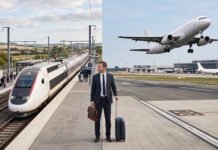












After the high-speed revolution, Guillaume Pepythe Chairman of the SNCFpresented the autonomous train as " the next rail revolution" . To embark on this adventure, the SNCF has just set up two consortiums, one dedicated to freight, the other to passenger transport, with the support of leading industrial and technological partners: Alstom, Bombardier, Altran, Bosch, Thales, Ansaldo... The aim is to get people driving in 2023 a different prototype for each entity thanks to a 57M budget financed to the tune of 30% by SNCF, 30% by the State and 40% by these private companies. The Etablissement public de sécurité ferroviaire (EPSF) and the Agence nationale de la sécurité des systèmes d'information (ANSSI) are also involved in the project to ensure and validate its completeness. security.
For the autonomous train dedicated to passengers, SNCF believes it will be able to increase transport capacity by 30% on rail lines that are already very busy. Passengers will benefit in terms of additional services and train regularity. The gains recorded on the metro line 1 and on the RER A between Vincennes and La Défense. " We'll be able to get closer to maximum capacity a line" says Patrick Jeantet, CEO of SNCF Réseau. While investment will remain high (research, track and train equipment, staff training, etc.), it will still be lower than the cost of building new high-speed lines, which runs into billions of euros.
The benefits for SNCF will also be significant, with growth in turnover linked to the increase in the number of passengers carried. And a lower energy costs from 15% to 20%, the autonomous train being more ecological thanks to automated management of acceleration and braking. This will also further reduce the train's CO2 consumption, which currently stands at around 11 grams per passenger/km carried (compared with 275 grams for air travel).
After the TGV prototype expected in 2023, operational deployment will first be carried out in 2023 on Eole, the extension of the RER EThis will be followed by the Paris-Lyon high-speed line in 2024-2025, at an estimated investment of between €500m and €600m. However, autonomy will only be classified as "GOA2" (Grade of Automation) out of the 4 development levels planned, with a driver remaining at the head of the train even though driving will be "hands-free". Regional TER trains should also reach the GOA3 stage, corresponding to automated driving. The line Marseille-Ventimiglia would be equipped at a cost of €500m. To achievecomplete autonomy - GOA4 -, further technological investment will be needed and SNCF will have to overcome passengers' reluctance to travel on driverless trains. " The human element remains important for intervening in degraded situations, particularly around unforeseen scenariosadmits Patrick Jeantet. Autonomous trains will have to be at least as safe as they are today" . Standards will also be established at European level, as high-speed trains already cross borders. To this end, SNCF has begun negotiations with Deutsche Bahn which is also working on the autonomous train.