The International Air Transport Association (IATA) has, as has been the tradition for several years, provided an update on the production of Sustainable aviation fuel (SAF)What still seemed to hold all the industry's hopes, has, over the years, become something of a 'token gesture' in the industry, given the lack of progress in production.
This is something the IATA has bitterly complained about, as it estimates that global production of sustainable aviation fuel (SAF) will reach around 2.4 million tonnes in 2026 – a mere 0.8% of total global aviation fuel consumption. The cost is exorbitant, as IATA estimates that this production will cost airlines around $4.3 billion. However, airlines will need around 500 million tonnes (Mt) of sustainable aviation fuel (SAF) to achieve their carbon neutrality target by 2050. We are therefore a long way off the mark…
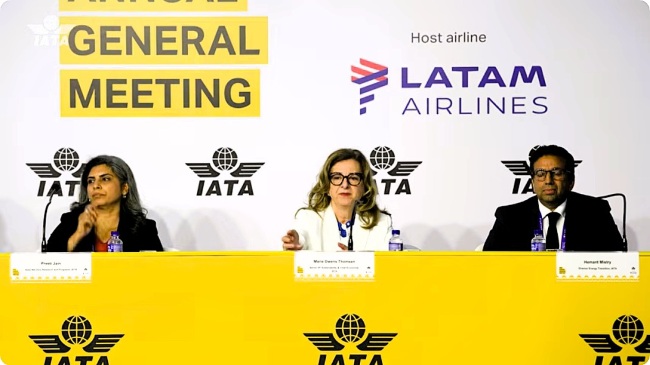
" Another disappointing year lies ahead for SAF production. Five years after the sector committed to achieving carbon neutrality by 2050, SAF will still account for just 0.8% of airlines’ fuel consumption this year. The target of meeting 65% of our energy needs with SAF by 2050 is becoming increasingly difficult to achieve each year due to poorly sequenced public policies and a clear lack of interest from oil companies ", he fulminated" Willie Walsh, IATA Director General, during his general address.
According to him, the current energy crisis should, however, accelerate the development of renewable energies, including SAF. " But we still do not see the implementation of the necessary incentives to create a viable SAF market, despite the stakes related to energy independence, employment, and the fight against climate change. "he added.
Four priorities to accelerate SAF development
In order to accelerate the ramp-up of sustainable aviation fuel, IATA is calling for coordinated action around four priority areas:
- To increase the production of renewable energies in order to guarantee the availability of raw materials and clean energy for the manufacturing of SAF.
- Ensure open access to fuel infrastructure, including pipelines, storage capacity and airport fuelling systems;
- Strengthen political support through production incentive mechanisms and investment frameworks offering greater visibility before the introduction of potential regulatory obligations;
- To foster the emergence of a global SAF market, with sufficient volumes and commercially viable prices to preserve the economic sustainability of air transport.
The association also believes that a global system of " book-and-claim » (“reserve and claim”) is essential for transforming the SAF market from a local to an international logic, by allowing airlines and producers to exchange certificates independently of their geographical location.
E-SAF to the rescue?
Alongside SAF derived from biological resources, e-SAF (electro-SAF) is set to play an increasing role in decarbonising air transport. Produced from renewable electricity using a "Power-to-Liquid" (PtL) process, it nevertheless requires significant quantities of green electricity, renewable hydrogen, water, and CO₂.
The European Union and the United Kingdom have set a production target of around 0.6 million tonnes of e-SAF by 2030. However, current global production capacity, either operational or under construction, only amounts to approximately 20,000 tonnes, with just one production site currently in operation.
To meet European and British objectives, around twenty large-capacity commercial refineries would need to be built. However, no new final investment projects have been approved in the last twelve months.
" The e-SAF targets set for 2030 by the UK and the European Union are not only unrealistic, they are totally out of touch with reality., estimates Marie Owens Thomsen, IATA's Senior Vice President for Sustainability and Chief Economist.
She criticises a strategy that imposes regulatory obligations even before production capacities are available. This approach can only lead to price increases and divert resources that could be used for effective CO₂ emission reductions. A credible strategy would first involve increasing renewable energy production, lowering its cost, and developing e-SAF industrial capabilities on a solid economic basis. ".
Passengers in favour of decarbonising air transport
And yet, the vast majority of passengers support the use of SAF. This is the finding of the latest IATA survey of travellers, conducted in April 2026. 89% of passengers believe that the industry must continue to reduce its emissions even if governments slow down their own environmental initiatives. A similar proportion consider that air travel is essential and that it should be made more sustainable rather than restricted.
This commitment is also reflected in a willingness to contribute financially to the transition. Around 66% of travellers say they are prepared to pay more to offset the emissions generated by their journeys, whilst 88% anticipate an increase in ticket prices due to environmental investments.
Passengers also favour concrete decarbonisation measures: 25% want funds to be prioritised for SAF and 23% for new emission-reduction technologies, far ahead of environmental taxes, which garner only 10% of the vote.
Passengers’ environmental awareness also influences their purchasing behaviour. Nearly one in two travellers (48%) checks carbon emissions before booking a flight. Of these, more than 85% say this factor influences their decision, whilst around three-quarters say they favour airlines with the best environmental performance.
Hope Brazil
Only the will of governments now remains, still too attentive to the lobbies of fossil fuels. And, of course, to producers of sustainable fuel. IATA, incidentally, stroked Brazil's ego, which was hosting the association's General Assembly.
Brazil, in fact, possesses one of the world's largest potentials for biomass, estimated at 180 Mt by 2050, which could enable the production of around 60 Mt of SAF, IATA highlighted.
By the horizon 2030, sustainable ethanol from sugarcane, as well as virgin and used oils available in Brazil, could represent nearly 18 Mt of raw materials, a production potential of around 12 Mt of SAF. This is five times the world production of SAF estimated for 2026.
Brazil is thus working on the production of sustainable aviation fuel. The country has about fifteen SAF projects under development. If they all come to fruition, they could bring around 2 million tonnes of additional SAF onto the market.