
















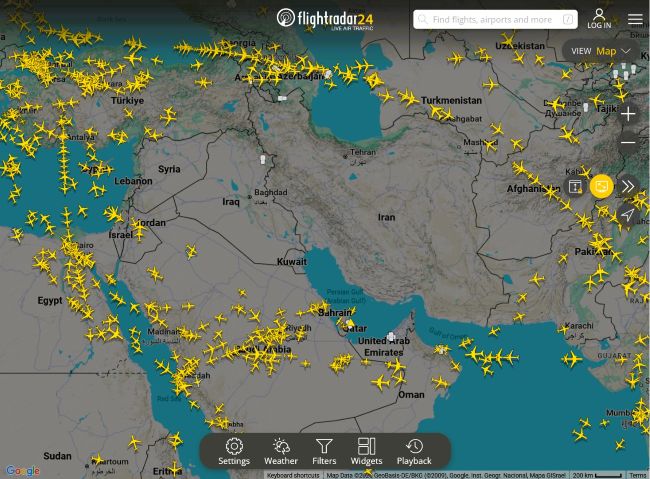
The launch by the United States and Israel of large-scale attacks against Iran had an immediate consequence for all travellers: the dislocation of the Persian Gulf as the world's hub.
While airlines had decided a few weeks ago to temporarily suspend some of their routes for security reasons - following the example of Lufthansa to Tehran and Tel Aviv - Iran's attacks on its neighbours have brutally brought to a halt one of the world's most important hubs for traffic between Europe, Asia and parts of Africa.
For the second day running, Iranian drones and missiles launched from Iran targeted Bahrain, Kuwait, Qatar and the United Arab Emirates - not to mention Israel. While most of the drones were intercepted, the debris from some of them ended up causing damage while threatening the security of the targeted countries.
Iranian drones in almost every Gulf airport
On 1 March, we learned that Terminal 3 at the international airport of Dubai - the world's leading international airport with more than 95 million passengers by 2025 - had been hit by a drone. This led to the outbreak of a fire and damage - albeit limited. But the Iranian drone forced the evacuation of the airport. At the same time, two drones caused damage to two hotels, the Fairmont on The Palm and the famous Burj Al Arab, a veritable icon of Dubai tourism.
In the neighbouring emirate of Abu Dhabi, drone debris caused the death of one person and injured several others at Zayed International Airport. Other Iranian drones also partially destroyed terminal 1 in Kuwait, while the Bahraini authorities reported only minor damage to the airport following an Iranian drone strike. Saudi Arabia announced that it had successfully shot down a drone flying towards Riyadh airport.
The authorities have also closed their airspace, and Emirates, Etihad, Gulf Air and Qatar Airways, joined on Sunday by Oman Air, have suspended their flights. According to the latest information from Etihad, flights could reopen on Tuesday afternoon. This information is, of course, subject to change.
Jordan has also closed its airspace due to its geographical proximity to Israel. Lebanon, for its part, has not yet closed its airspace. However, many airlines - such as Air France - have suspended their services to Beirut.
Saudi Arabia's airports are also remaining open, but many flights to the rest of the Middle East have been suspended.
World air transport affected by ricochet effect
Even more serious is the disruption to traffic flows in the rest of the world - and particularly in Europe. The consultant Cirium has put the number of flights cancelled between Saturday and Sunday at around 1,700.

In addition to the Gulf airlines, Air France, British Airways and the Lufthansa group, among others, have stopped serving the region. This has led to a sudden drop in transfer passenger traffic to other parts of the world. In Dubai, for example, transfer passengers accounted for 40% of the total arriving at the hub. This figure would rise to 74% in Doha!
According to the consultant OAGBy 2025, Dubai would be the world's second-largest airport in terms of the number of seats offered, behind Atlanta, at 62.4 million. But unlike Atlanta, which remains essentially domestic, Dubai's traffic is exclusively international. In the OAG rankings, Doha ranks 10th with 32.68 million seats.
Also according to OAG, in February 2026 Emirates ranked as the world's largest international airline in terms of available seat kilometres (ASK) and is expected to operate 29.7 billion ASK this month, 49 % more than Qatar Airways, which nevertheless ranks as the second largest international airline with 19.9 billion ASK. Etihad came 14th with ASK 9.7 billion, again according to OAG. So it's easy to imagine that the suspension of flights by these three carriers is causing a great deal of concern for passengers at airports around the world.
The airport authorities are asking travellers to stay at home and check with their airline whether flights are taking place before going to the airport. Unfortunately, the situation could drag on, even though Emirates and Qatar Airways have announced that they intend to resume their flights this week. Air France has announced that it is suspending flights to and from Tel Aviv, Beirut, Dubai and Riyadh until 3 March 2026. It will reassess the possibility of resuming flights in due course. For its part, Malaysia Airlines said at midday on Monday that all its operations to and from Paris and London to and from Kuala Lumpur were "fully maintained and operating according to schedule". However, the airline said it had been forced to "deploy alternative routes in order to avoid currently sensitive areas", and warned that "these adjustments may result in slightly longer flight times".
The greatest uncertainty therefore reigns. Especially since Donald Trump announced on Sunday evening that he was planning a military operation "lasting at least four weeks". If this really is the case, it could jeopardise the status of the "Middle East-air-hub-of-the-world".