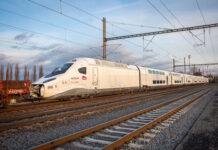
High-speed trains have become a hallmark of a country's modernity. France, Germany, Spain, Italy, Sweden and, in Asia, Japan, Korea, China and Taiwan are proof of this. India is set to join the club in the near future.
For the time being, theSouth-East Asia still lagging behind despite the proliferation of projects and the symbolic high-speed line linking Kuala Lumpur to its airport. Yet this part of the world has no shortage of ambitions.
The planned pan-Asian rail link between Kunming in China and Singapore was the great monumental project of the early 21st century.. In fact, there are three projects with different routes. The first, unveiled in 2000, is a 5,500 km rail link between Kuming and Singapore via Hanoi, Ho Chi Minh City, Phnom Penh, Bangkok and Kuala Lumpur. It has now been renamed the "Oriental Line". In 2004, the "Western Line" was unveiled, linking the same two cities but this time via Burma, Bangkok and Malaysia. Finally, in 2007, the ASEAN (Association of South-East Asian Nations) countries approved a third option, the "Central Line". This time it links Kunming to Singapore via Cambodia, Bangkok and Malaysia.
Apart from this project, theIndonesia wants to build two relatively high-speed lines (140 to 160 km/h) linking Jakarta to Bandung and Surabaya. In the Philippines, there are also plans to connect Manila to the north of the island of Luzon.. At Vietnamthe authorities are finalising a project that is more than a decade old for a high-speed train from Hanoi to Ho Chi Minh City.
The Kuala Lumpur-Singapore route is a thing of the past
Except that in the meantime, there is little chance that any of these lines will see the light of day in the near future. Between changes of government, budget revisions, collusion between political and economic circles, and mistrust of China, which finances many of these projects, high-speed rail in South-East Asia is in the doldrums.
In 2021, the Malaysia has officially abandoned plans for a high-speed train from Kuala Lumpur to Singaporewhich would have linked the two cities in 1.5 hours instead of 5 or 6 hours with a conventional train. The argument put forward was that the cost of such a project was too high.
In theIndonesia neighbouring country, the government is faced with soaring costs for the Jakarta-Bandung high-speed line built with Chinese capital. Work is already three years behind schedule, while the cost of the line has risen from 5.5 to 8 billion dollars between 2015 and this year.
Experts estimate that 80% of the line has now been completed, but the Indonesian government is now being forced to pay off a debt that continues to swell in favour of its Chinese partner. When the line opens in early 2023, it will put Bandung 45 minutes from Jakarta.
Delays across the board for Indonesia and Thailand
Indonesia is also modernising the Jakarta-Surabaya line via Semarang, this time with financial and technological support from Japan. Work has begun on the line, which will enable trains to travel at an average speed of 145km/h instead of the current 90km/h. The line is due to enter service in 2024 and will link the two cities in less than six hours.

La Thailand has also embarked on an ambitious plan to build high-speed rail lines linking Bangkok to the north-east of the country and to the country's central regions. Five lines were approved by the government and parliament in 2010. However, in the meantime, the government has changed and has called into question the awarding of the line concessions. They have now been confirmed, but the delays are mounting.
Two lines are taking shape. The first will link Don Mueang airport in the north of Bangkok, the centre of the capital, Suvarnabhumi airport, Pattaya and finally U-Tapao airport. (now known as Bangkok's third airport) to the south of the seaside resort. The trains would travel at 250 km/h, providing a link between Bangkok's two airports in less than 30 minutes and Pattaya/U Tapao in 40 minutes. The project has been approved and work is due to start on a scheduled to open in 2026/2027.
The other, most advanced project is the line linking Bangkok to Nakhon Ratchasima with extension to the border with Laos. An 840 km long line financed by China. Except that for the moment only the first part of the line is under construction. It will link Nakhon Ratchasima - Thailand's second largest city with a population of 300,000 - to Bangkok in just over an hour. The line was initially scheduled to start operating in 2022 and then 2023. There is now talk of 2025…
The second part of the line will run to Nong Khai and Laos.. Construction of this part of the line has not yet begun. No precise date has been given, but it is estimated that the project could be completed around 2030! It was also intended to connect Thailand to China via the new high-speed line running through Laos.
Laos, the only country in South-East Asia with a high-speed train
For the time being the only high-speed train project on an international line that will become a reality in South-East Asia. Built and financed by China, it crosses Laos over 427 km, including 198 km of tunnels. Begun in 2016, the line is the first real rail link in the country, apart from a small 5 km section connecting a suburb of Vientiane, the capital, to the Thai border. The train will link Vientiane to the Chinese border via the historic town of Luang Prabang.. It will now be just over two hours by train from the Laotian capital. The official opening is scheduled for the end of the year.
Finally, there has been talk for many years of a high-speed train linking Hanoi to the former Saigon, over a route of 1,570 km. The current diesel-powered trains run partly on a single track, linking the two cities in... 29 hours! If a Shinkansen-style train project is adopted, the journey time would be reduced to 5.5 hours. If a cheaper (and slower) version is chosen, the journey would take 8 hours.
This high-speed line was first mooted in 2007, abandoned and then revived in 2012. Last year, the government indicated that it had entered the active phase of the project. Work has begun on two sections between Hanoi and Vinh in the north and between Ho Chi Minh City and Nha Trang in the south. These two sections could open around 2032. The rest would be completed by 2045.
Also in the former Indochina, there has been talk since the French era of a railway line connecting Phnom Penh to Ho Chi Minh City only 230 km apart. But here again, nothing has really materialised, despite two agreements signed by the Cambodian and Vietnamese governments. So regional airlines still have a long way to go!
Special report: the adventures of high-speed rail around the world
High-speed trains have the wind in their sails
The triumph of high speed in China
- High-speed train networks derail in South-East Asia
High-speed rail is making inroads in the United States
The Americas between desires and financial constraints