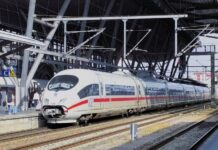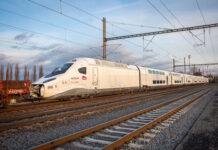


















It was an angry tweet from an American internet user in December 2019. He highlighted the fact that 35 high-speed trains cover the distance between Beijing and Shanghai every day in 4.5 hours. And that, by comparison, on the Chicago to New York line (which has almost the same mileage), there was one daily train covering the route in... 19 hours. On Chicago-New York, as on many other US rail lines, trains travel at less than 130 km/h. Exactly the same speed as a hundred years ago!
Automobile, financial and urban obstacles
Cementing high-speed rail around Amtrak

California dreamin'
But it will be California, which is set to be the site of the first truly high-speed rail line in the United States. Trains on a line linking San Francisco to Los Angeles via San Jose, Fresno and Bakersfield would travel at a speed of 350 km/hour this 830 km corridor. The two metropolises would then be just 2 hours 45 minutes apart by train. At the same time, a new line will be built linking Phoenix and Tucson, serving 15 stations over a 140-mile network.
Until now, the project has been at a standstill due to a lack of funding. A single 190 km section is currently under construction, linking Bakersfield and Merced via Fresno.. From San Francisco, trains would temporarily resume their snail's pace to San Francisco.
The approval of the Biden infrastructure plan by Congress on 5 November should enable California to receive an additionalsome thirty billion dollars to complete its high-speed network. This would mean accelerating the rail routes to Los Angeles to the south and San Jose/San Francisco to the north. The high-speed line is scheduled for completion in 2025, with train trials scheduled for completion by 2027 for a commissioning between 2028 and 2029.
After 2030, two extensions are planned, the first towards Sacramentothe second towards San Diego. It would make it possible to serve all California's major cities by TGV in less than five hours from end to end.
Another project - this time entirely private - is likely to be the the first TGV line in the American West to become operational: the Las Vegas-Victor Valley in Southern California. Led by private rail operator BrightLine (which already operates a route in Florida), the 270 km line would be served in an average of 1 hour 25 minutes (i.e. 180 km/h). With the possibility of a branch line to Los Angeles and Palmdale. Inauguration is scheduled for around 2025.
Florida and Texas, the future at high speed
In Florida, BrightLine operates a Miami-West Palm Beach route, to be extended to Orlando and Disneyland in 2023. With an average speed of 130 km/h, which will rise to 200 km/h on the Cocoa-Orlando route once the line is inaugurated. According to the International Union of Railways (UIC), this train does not qualify as a high-speed train. The UIC defines a TGV as a train travelling at 200 kph on an existing line and 250 kph on a new line.

Finally, at Texasthe Houston-Dallas high-speed line takes shape. Serving a catchment area of 13 million people, it is expected to handle more than 6 million passengers a year by 2029. High-speed trains will cover the 380 km separating the two megacities in 90 minutes. This compares with an average of more than four hours by car. A powerful argument!
Special report: the adventures of high-speed rail around the world
High-speed trains have the wind in their sails
The triumph of high speed in China
High-speed train networks derail in South-East Asia
- High-speed rail is making inroads in the United States
The Americas between desires and financial constraints