












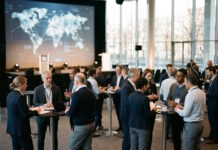





Discretion seems to have become a virtue in Ljubljana, the capital of Slovenia, which became a member of the European Union in 2004. This is a small country of barely two million inhabitants that has hardly made any waves since gaining independence nearly twenty years ago. Of all the countries in Central and Eastern Europe, Slovenia is probably the most successful in its integration into the EU-27. In fact, Ljubljana was the first to adopt the euro. It is also the new EU member whose standard of living is closest to the European average. According to Eurostat statistics, Slovenia's GDP in 2009 was equivalent to 87 % of the EU average, ten points higher than Portugal or the Czech Republic.
French locations
Admittedly, 2009 saw GDP fall by almost 8 % after years of rapid growth, the result of a Slovenian manufacturing industry that is highly - some would even say overly - dependent on its neighbours, Austria, Italy and Germany, three countries shaken by the 2008-2009 crisis. Yet 2010 has confirmed Slovenia's economic recovery, and the country's strengths are real: its workforce is well trained and multilingual, while its infrastructure is comparable in quality to that of Austria or France. From Ljubljana, Vienna is only four hours away, Trieste two hours and Zagreb one and a half. The substantial improvement in relations with neighbouring Croatia should confirm Slovenia as the EU's main gateway to the countries of the former Yugoslavia. It's hardly surprising, then, that France's Renault, Sanofi and Saint Gobain companies have had a presence in Slovenia for many years. Renault, through its subsidiary Revoz, produces Clios and Twingos near Ljubljana. The country's second largest bank, SKB, has been part of the Société Générale group since 2001. In France, it's hard not to be seduced by the charm of this metropolis on a human scale, with just under 300,000 inhabitants.
More than anywhere else in Ljubljana, the city's openness to Europe is reflected in BTC City, its most recent district. Designed by the Slovenian logistics group BTC, BTC City opened ten years ago on the edge of the motorway as the largest shopping centre in Central Europe, with the aim of attracting shoppers from all over the region. In May 2011, it will be joined by a 90-metre tower, the heart of a 270-hectare development project. Crystal Palace will include a conference and convention centre, a thalassotherapy centre, a shopping arcade, a restaurant and panoramic café, as well as office space. And it hopes to establish itself as one of the leading business addresses in Central Europe.
Identity card
- Currency: the euro.
- Language: Slovenian; most people speak English, German and Italian; some French.
For more information
- Slovenian Tourist Office Rue d'Idalie 19/3 - B 1050 Brussels Tel: +32 2 644 27 04 Internet : www.slovenia.info
- Ljubljana Tourist Office Internet: www.visitljubljana.si/fr
- Invest Slovenia Tel: +386 1 589 18 70 Internet: www.investslovenia.org
- French Embassy Economic Department Tel: +386 1 479 04 52 E-mail : ljubljana@dgtresor.gouv.fr
How to get there
There are several daily flights between Ljubljana and Paris. The national carrier Adria Airways (a Star Alliance member) and Air France each offer two daily flights. Easyjet will launch three weekly flights from Paris on 2 December.
Internet : www.adria.si / www.airfrance.com / www.easyjet.com
Ljubljana-Brnik airport is 35km to the north. It costs €40 for a taxi and €4.10 for a shuttle bus to the central station. Internet : www.lju-airport.si
A few hours of freedom...
What Gaudi was to Barcelona, Joze Plecnik is to Ljubljana. Slovenia's most famous architect was a genius who worked in his city for half a century. His most emblematic creations include the three-limbed bridge over the Ljubljanica river and the State Library, probably his most spectacular masterpiece. A museum is dedicated to him, and you can also visit his house, where the spirit of the genius still breathes.


