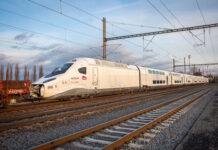

















On 21 May, Renfe will start running around ten of its new AVE S-106 trains. These high-speed trains, designed by the Iberian manufacturer Talgo, are intended by the Spanish railway company to be a real success. spearheading its growth this year. Firstly, because they will make it possible to launch high-speed links in Asturias by reducing journey times on this route, but also to serve new towns in Galicia, including Vigo, Pontevedra, Vilagarcia, Santiago and A Coruña, again with a reduction in journey times of up to 18 minutes.
More broadly, these latest-generation trains will, above all, enable the company to increase its capacity across its entire network, thanks to their greater capacity, with 12 cars for more than 500 passengers. Renfe also intends to use this crucial point to increase volumes in France and lower the break-even point on its Paris-Lyon-Marseille and Paris-Barcelona routes. With an average occupancy rate of 80%, the company has announced that it has already sold more than 500,000 tickets on its France-Spain routes launched in July 2023.
The aim now is to quadruple its offering by increasing the number of AVE S-106 trains from 4 to 16 a day, to bring its trains to Paris-Lyon station - ideally during the Olympic Games, or if not, in September - and to increase "the number of trains to Paris-Lyon station". international and national connections in the French market" says the company. Three new stations could be added to the current services: Lyon Perrache, Montpellier Sud and Nîmes Pont du Gard.

From 21 May, a game of musical chairs will be played across the entire high-speed network. The old-generation trains (Alvia S-730, S-130 and S-121) will be replaced by the new S-106s, which will in turn be replaced by the new S-106s. increase the number of services on the main corridors serving the communities of Andalusia, Extremadura, Catalonia, Aragon, Castilla y León, Castilla la Mancha and Madrid. In the capital, major works are underway until the end of July at Chamartin-Clara Campoamor station to adapt to the increase in traffic and to accommodate AVEs. Overall, Renfe is counting on an increase in seat capacity of 20,000 seats per week. Four Avlo trains, its low-cost offering, will also be reallocated to increase certain frequencies at peak times, particularly in southern Spain.
Greater comfort and more services on board
As part of a five-billion-euro renewal of its fleet, Renfe has ordered no fewer than 30 AVE S-106s with the aim of having "the most modern fleet in Europe" . These high-speed trains will offer passengers greater comfort, a wider choice of seats with 2+2 square, 3+2 (or even 3+3 according to the visuals) configurations, as well as new services with touch screens for all seats and a cafeteria.
With these new travel standards, and more frequencies for its low-cost Avlo service, Renfe hopes to better resist SNCF's foray into the Spanish market. with its Ouigo trains. Spain's Transport Minister Oscar Puente recently criticised the French carrier, accusing it of practising " unfair competition "Renfe's strategy has been to sell its tickets at a loss, with a deficit expected to reach €40m for the year, provoking a global fare war and a plunge in Renfe's results. With the arrival of its AVE S-106s, Renfe intends to give SNCF a run for its money in France.