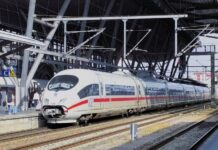
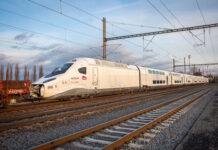
La Deutsche Bahn (DB) is more often in the news for its delays than for its network improvements. Nevertheless, the 2026 timetablewhich comes into force on 14 December, will include a number of innovations. One of the most important is the expansion of the long-distance high-speed train service. These trains will serve 21 towns every half-houralmost double the current service. The high-speed network has grown from 900 to 2,300 km. This extension concerns in particular the Hamburg-Hanover-Cassel and Erfurt-Halle-Berlin routes.
The network covered by the fastest high-speed trains, the ICE Sprinter, is being strengthened with 14 new high-speed connections. They offer shorter journey times. Like the Berlin-Stuttgart route via Nuremberg. It will take 4 hours 45 minutes, a saving of more than an hour. <The Berlin-Frankfurt route will take just 4 hours. That's a saving of 20 minutes on the current route. This will in turn benefit the Berlin-Paris route, which passes through Germany's financial metropolis.
To improve punctuality, DB is also maintaining long-distance services for smaller townswhile at the same time rationalising its services. Instead of scattering lines, the railway company will concentrate its rail services on a limited number of routes, served at high frequency. This should help avoid delays and improve service reliability.

International expansion and technical innovation
International traffic is growing strongly, with around 40 new daily connections to nine European countries.. This includes Belgium (Frankfurt-Brussels increased to 16 daily connections), Poland, Switzerland and Denmark. New routes include Leipzig-Crakow, Prague-Copenhagen (from May 2026) and Cologne-Antwerp via Brussels (from September 2026).
Customers can now easily book international journeys via bahn.de or the DB Navigator application. The two sites also integrate the French TGV, Eurostar and ÖBB night trains. This harmonisation is made possible by the European Union's OSDM standard, which provides a common standard for all European trains. By the end of 2026, the DB website will have integrated all the reservation systems of the main European rail carriers..
Infrastructure modernisation work is continuing, particularly on the following lines Hamburg-Berlin, Nürnberg-Passau and Cologne-Frankfurt, with temporary adaptations to the service. The modernisation of Berlin-Hamburg, one of Germany's most important lines with more than 60 trains a day, will be completed at the end of April.
Bookings for the new calendar will begin on 15 October 2025with availability for up to 12 months for national journeys and 6 months for international journeys.