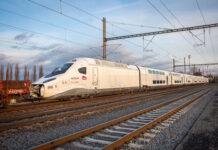


















Expected on the 1ster July on the Paris-Lyon-Marseille axis, it is finally at the beginning of September that the TGV M should finally begin its commercial operation. And this, even if this TGV of 5e The generation has finally obtained its approval from the European Union Agency for Railways (ERA). Although the commercial loss for the summer season is significant for SNCF, the company prefers to wait until the autumn rather than having to deal with potential breakdowns on new equipment packed with passengers on the TGV Méditerranée line.
The media impact of these risks would be very negative, especially as SNCF Voyageurs has been communicating extensively for years about the advantages of this TGV 5.e generation: modularity and interoperability of trains, a 20% reduction in energy consumption and a 32% reduction in CO₂ emissions2, a 20% increase in capacity with 740 passengers, and 97% recyclability for this TGV… During this period, the SNCF will therefore continue to operate the trains already manufactured by Alstom on the national network to ensure their complete reliability.

Having begun in June 2023, these services, running between the conventional TGV services, will allow for the continued training of staff assigned to these new trains, particularly the drivers. As a reminder, the initial commissioning of the TGV M was planned for December 2023, then for the Paris 2024 Olympic Games before suffering several other postponements, much to the dismay of SNCF Voyageurs, who consider this train a strategic advantage against the competition from Trenitalia and future competitors such as Velvet.
7 or 8 trains available in September
While SNCF planned to have 4 train sets by early July, it is expected to operate 7 or 8 in September and 13 by the end of 2026, provided Alstom can maintain the production rate of this Avelia Horizon type train. SNCF has indeed ordered no fewer than 115 of these TGV M trains, split between 100 sets dedicated to the national network and 15 in an international version that will serve Italy. For its international subsidiary Eurostar, the group has also signed a contract for 30 trains (+20 options) to be delivered from 2030 onwards.
To achieve this, Alstom has set up a new production line at its Belfort plant to assemble the power cars, while the passenger carriages are assembled near La Rochelle. In total, 10 of Alstom's French sites are involved in the construction of this train of the future, the production of which is proving more than complicated to industrialise due to its 400 technical and industrial innovations. Each new delay therefore impacts the development projects of SNCF Voyageurs and, in the future, its international subsidiaries.