
















Faced with the saturation of its rail network, but also with global warming and the carbon emissions of air travel, India is converting to high-speed rail to connect its megacities in a country of 1.45 billion inhabitants. The first high-speed line (HSL) is under construction between Mumbai, the economic and financial capital located in the state of Maharashtra, and Ahmedabad, the main city of Gujarat, a state in western India. The 508 km line will allow passengers to travel between these two cities in nearly 2 hours, compared to 9 hours currently by train and 6 hours by car.
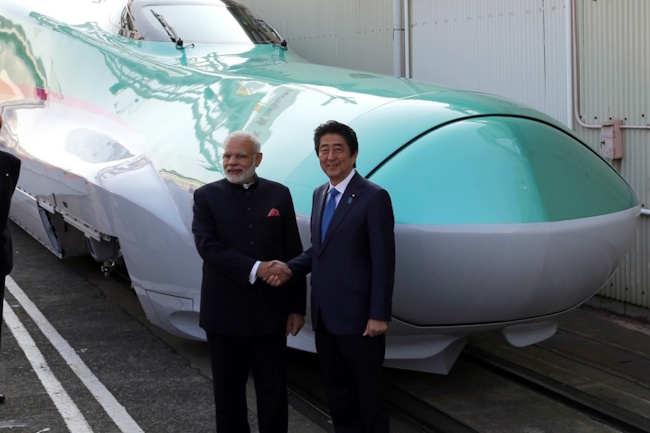
The cost of the project is estimated at 17 billion dollars, financed through loans from Japan at an interest rate of over 80%. In return, Japanese signalling technology and Shinkansen trains have been selected for this new line. India will thus become the second country, after Taiwan, to adopt this Japanese rail technology. An initial section of around 100 kilometres is due to be opened in 2027 between the cities of Surat and Vapi, ahead of the high-speed line’s full opening a year later. This ambitious project is now three years behind schedule, having been originally scheduled to commence commercial operations in 2024.
A desire to modernise the Indian railway network
The government of Prime Minister Narendra Modi intends to modernise the Indian railway network with the aim of constructing approximately 4,000 km of high-speed tracks for 7 lines that are set to connect several major cities across the country. Indeed, while India possesses a particularly dense railway network with 132,000 km of track and around 8,000 stations, it is at its limit, with lines dating back to the British era and overcrowded trains operating at low speeds.
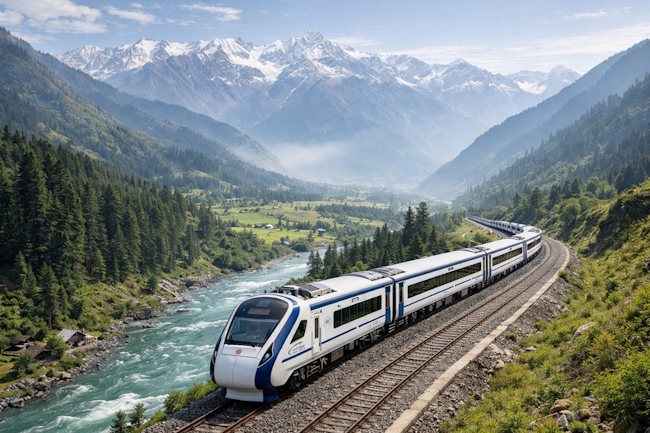
Since 2019, India has taken its first step forward with the launch of the Vande Bharat Express, a fleet of Indian 100% trains capable of speeds of between 160 and 180 km/h. More than 70 cities are already served, including New Delhi, Mumbai, Chennai, Bangalore, Trivandrum, Pune, Brahmapur and Bangalore… Whilst a second, more modern generation of Bharat Express trains is set to be launched from 2024 – featuring air conditioning, Wi-Fi and catering facilities – India intends to export an adapted version of these trains to neighbouring countries such as Nepal and Bangladesh, as well as to Africa and Latin America.