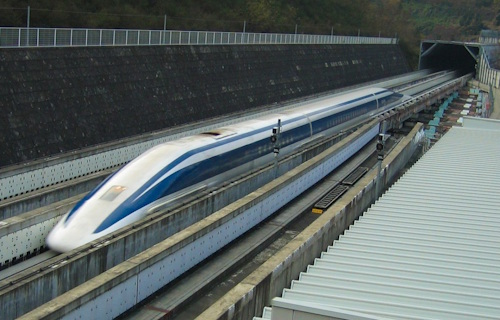
Japan is making a strong impact in the railway sector. Following its renowned Shinkansen, the country has just given the green light for the construction of the first magnetic levitation line between Tokyo and Osaka, some 500 km apart, passing through Nagano, Nagoya, and Kyoto, among others. The project has seen significant progress in recent days, with the Shizuoka prefecture, which had opposed the project for environmental reasons, finally giving its agreement.
Initially, the Maglev, JR Tokai's magnetic levitation train, will travel at 500 km/h between Tokyo and Nagoya, covering 370 km of the total route. However, the extension to Osaka is already planned, which will reduce the journey time to the Japanese capital to about 1 hour, compared to the current 2.5 hours by Shinkansen.
Japan will thus remain the nation operating the world's fastest commercial train. It already is for testing, with a Maglev train having been pushed to 603 km/h in April 2015. Tested for decades in Japan, the technology, which relies on the use of magnets, is said to be revolutionary, with the trains literally floating above the tracks, which eliminates friction when the Maglev is launched at full speed.
A nearly entirely underground Maglev line
The cost of the project is, however, colossal, estimated at 60 billion euros, as nearly 90% of the line between the two megacities will be underground. The longest tunnels, running through mountainous areas, could be up to 25 km long. They also offer certain advantages, such as protection from the elements and greater resistance to earthquakes, which are particularly common in the archipelago.
These tunnels will also resolve the issue of noise and the blast effect from trains travelling at speeds of 500 km/h. Maglev trains will have to run on a straight line due to this high speed, which prohibits any curves on the route. The project for this line, planned as early as 2013, anticipated an opening in 2027. This is now expected in 2045.