
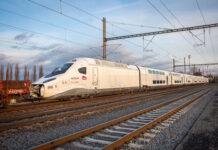














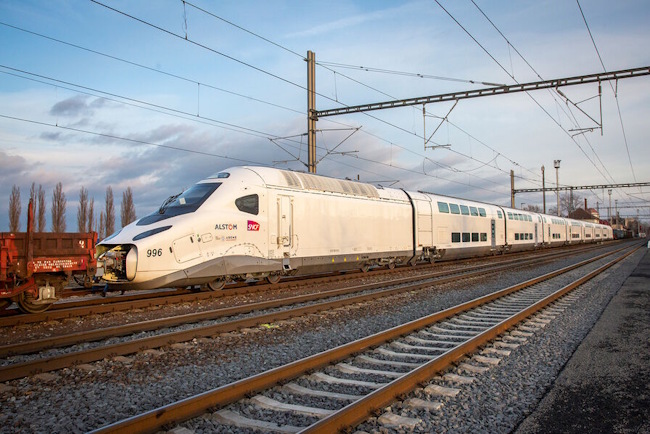
The official date for the commercial launch of the TGV M is approaching. Perhaps on Monday 2 November, with two return trips, as some rail enthusiasts blog? Or on Friday 6 November, the day of the inaugural journey between Paris and Marseille? The latter will take place in the presence of the press and officials: Philippe Tabarot, Minister of Transport, Jean Castex, CEO of the SNCF group, Jean-Aimé Mougenot, new CEO of SNCF Voyageurs, and Karine Dussert-Sarthe, new director of TGV-Intercités. The only missing piece is President Emmanuel Macron, who was once expected to attend.
The TGV M built by Alstom seems finally to have overcome its technical problems, and the SNCF decides to launch its fifth-generation TGV three years later. In fact, the first carriages were initially expected in late 2023, then for the 2024 Paris Olympic Games, before the delays piled up.
With one million kilometers under its belt, the train has been subjected to testing campaigns up to 320 km/h since June 2023 on the high-speed network, under all traffic conditions (single or multiple units, degraded modes, weather conditions, etc.). A pre-commercial run in real conditions, with fake passengers, followed in order to validate all the onboard life-support equipment, such as the wheelchairs, the toilets and the new Le Bistro bar, which is spread over two floors and operates on a self-service basis. The TGV M thus obtained its market authorization in May, issued by the European Union Agency for Railways (ERA). However, new issues, notably regarding the batteries and the boarding system for people with reduced mobility (PMR), have compromised its launch at the beginning of the summer., then at the beginning of the new school year.
A more energy-efficient TGV M
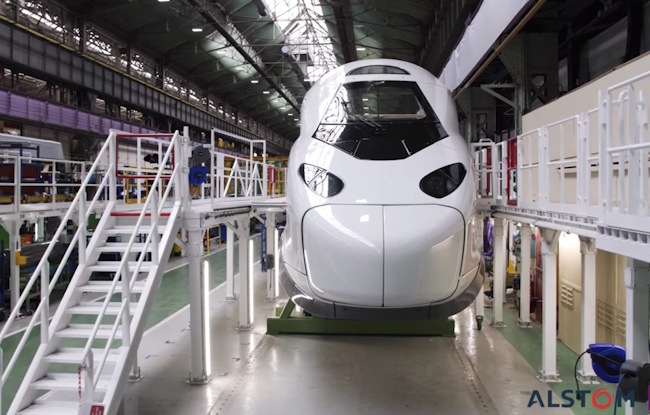
The Avelia Horizon, the commercial name of the TGV M at Alstom, contains no fewer than 400 patents. Ten Alstom sites are involved in its manufacture, including the assembly plants in Belfort and La Rochelle. SNCF points out that the French manufacturer has designed a more environmentally friendly train, which should generate 32 % fewer CO₂ emissions and 20 % energy savings, thanks in particular to the locomotive’s more aerodynamic nose. In terms of operation, SNCF Voyageurs expects a 30% reduction % in maintenance costs. Moreover, when these trains reach the end of their life in a few decades, 97 % of their components will be recyclable.
A major innovation: the TGV M is equipped with batteries. In the event of a power failure on the track, they allow it to maintain comfort on board (air conditioning, lighting, toilets) and travel 40 to 60 km, allowing it to leave the high-speed line or reach the nearest station.
More capacious and adaptable TGV trains
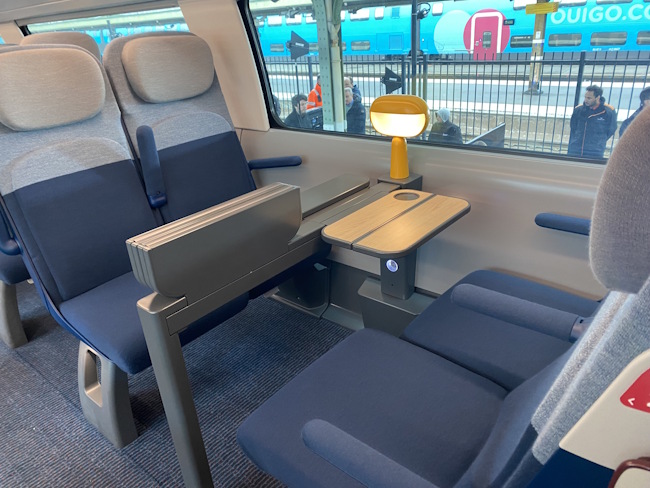
For a total of 4 billion euros, SNCF has ordered 160 copies of the TGV M, of which 30 units will be delivered to Eurostar starting in 2030. SNCF wanted a train that is more modular and more capacious. It thus has nine passenger cars, compared with eight for the current TGV trains, for a capacity gain of 20 %, with 740 seats. On paper, a first-class car can be converted into a second-class car, and vice versa. It remains to be seen, in practice, whether SNCF will exploit this possibility.
The spaces dedicated to bicycles and especially to luggage have increased by 20 %%. The onboard connected service is also being enhanced, in order to improve the quality of the Wi-Fi (a satellite solution is currently being tested) and to provide passengers with real-time information on screens.
SNCF currently has seven train sets, and thirteen are planned by the end of the year. They will be gradually integrated into its inter-urban transport plan. Paris and Marseille. From 2028, several TGV M trains will be dedicated to the expansion project in Italy, on the Paris-Milan, Turin-Rome and Turin-Venice lines. It should be noted that Velvet, a future competitor of the SNCF on the Grand Ouest, has ordered twelve copies of the Avelia Horizon, in a version that should not include backup batteries.