

















" Do you know why the people of Havana prefer to walk on the road rather than on the pavement? Because they're always afraid of a stone falling on them..."In the face of hardship and ridicule alike, Cubans reserve the right to exploit the most precious resource in a situation of great frugality: humour. But is the passer-by's remark really a joke? It's true that you'd almost hesitate to venture under the roofs of the decrepit villas with neo-Corinthian or faux-doric colonnades that line the alleys of Vedado, the central district of Havana.
You don't have to be an engineer to realise that this is a city that's in a rut. But among the three million or so tourists who passed through in 2014, you won't find many people complaining. Clearly, people don't come to Cuba in search of something new; they come for a rest. In Havana, no one will see the latest building by the star architect of the moment, or the exclusive bar launched by an ultra-trendy designer. It's clear: trend addicts have no place in this city. Rather than exhausting itself chasing the buzz, the city invites you above all to listen to the purr of an old American car engine, to chase ghosts in palatial mansions restored to nature; in short, to plunge in peace into a postcard that stubbornly refuses to suffer the ravages of a world that is certainly changing, but elsewhere.


Sin City in the Caribbean
Escape from routine modernity: that's what you have in mind when you choose to set down your suitcases in Cuba rather than in a common Caribbean destination. You try it in the narrow streets of Habana Vieja, amidst a scrupulously preserved colonial heritage. Above all, you can try it out in the intact memories of the "pre-revolution", the 40s and 50s when Havana was transformed into the American capital of pleasure, where the smell of cigars was always mixed with a hint of sulphur.
Let's get the ambiguity out of the way straight away: for all the charm of the patina, we're talking about a landscape that, at the time, looked more like Gomorrah than the Garden of Eden. "In Havana harbour, the night spots had taken over. Fabulous cabarets and hotel-casinos were springing up at a rapid pace, and the brothels followed suit. Lucky ball, bingo, lotto, dice and card games: you could try your luck on any street corner. Marijuana was widely available. There was hardly a place in the city where you couldn't find a drug dealer, a gambling table, a henchman and hundreds of prostitutes."This is what Havana looked like in 1957, according to a well-documented book on the local mafia, readily available from any good bookshop in the Place d'Armes1.
There's no doubt that behind the wild parties and the parade of stars, this glamorous era had its downside. But there's no doubt about it either: it still had a certain flair. Fortunately, we haven't wiped the slate clean of this underworld period, either out of good taste or lack of funds. You'll find the essence of it under the glitter and neon lights of the Tropicana cabaret, in the swimming pool at the Capri, on the worn leather of the club chairs at the Hotel Nacional, on the palm-lined avenues of the Miramar district or, quite simply, in front of the incessant ballet of Buicks, Cadillacs, Chevrolets, Studebakers and Pontiac coupés that have been delivered to the ingenuity of Cuban mechanics for over half a century...


Havana, "the city of a thousand columns", is of course a city of graceful arcaded houses, patinated buildings and the elegance of a conquistador. But above all it's an atmosphere, a mixed sensuality, a heady nostalgia that grips the traveller body and soul. These are the foundations on which the Cuban capital envisages its future, renovating its charming streets as best it can.


At the bar, Hemingway
This tour of an unspoilt past has its own literary variation: the Hemingway tour, whose initial stops are concentrated in the old town. La Bodeguita del Médio, where he drank. The Floridita, where he continued his drinking. Finally, the Hotel Ambos Mundos, where he rested after his orgy of daiquiris and mojitos. But the tour inevitably continues at Finca Vigia, the large house where the writer ended up in exile from 1940 to 1960, a respectable distance - about fifteen kilometres - from his favourite haunts of debauchery, so that he could concentrate more easily on his work. And not the most minor part: from this residence surrounded by tropical forest came For Whom the Bell Tolls and The Old Man and the Sea... Clearly, the place is inspiring. "Paris, Spain, Cuba and his home town: these were the four places to which the author was most attached."As the director of the Hemingway Museum reminds us as she welcomes visitors to the garage where he once parked his seven cars. The jolts of history have brutally removed the old man from this haven of peace, where he intended to extend his stay: "When his friends asked him why he stayed at Finca Vigia, Hemingway replied: 'because it's fifteen minutes from the golf course, I can get off the phone and I can organise cockfights without being bothered'. "...
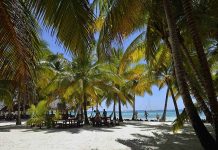
Dreaming of his next expedition on the Pilar - his yacht moored in the small fishing port of Cojimar - Hemingway was well aware that, in Cuba, all roads lead to the sea. And it is rare for visitors to Havana to end their stay without a taste of the clear, warm waters of the ocean or the Caribbean Sea. There are several options for leaving the capital. There's the simplest solution: the Playas del Este, just 20 kilometres away. There's also the easy option of Varadero, a mecca for mass tourism, with 15,000 rooms spread over some fifty hotels run by the major Cuban and foreign chains. But while we're on the subject of glamour, we might as well stick around and look a little further afield for a more unique destination, one of the island's 5,746 kilometres of coastline.


Natural luxury
For the last fifteen years, this unique island has had a new name: Cayo Santa Maria. This island in the "King's Gardens" archipelago is reached by a new road some fifty kilometres long, running between the ocean and the mangrove swamps. Since the road was opened in 1999, eleven hotels have been built on Cayo Santa Maria, almost all of them five-star. There are already 6,700 rooms on the Cayo, and there will undoubtedly be 6,000 more in a few years' time. Enough to satisfy everyone's desire for a change of scenery, but also for refinement. "Natural luxury: that's our signatureexplains the local representative of Gaviota, the agency entrusted with Cayo Santa Maria's tourism operations. Here, the mangroves have not been cut down, and we are taking care to ensure that the construction of a new hotel never encroaches on nature.". It's enough to guarantee a bit of peace in the setting, even if the Cayo already boasts a number of facilities (a marina, a dolphinarium, two tourist villages, etc.) to provide a variety of pleasures.


The joys of the road
Havana, the beach, but also the colourful alleyways of Trinidad, the cigar factories of Pinar del Rio or the mogotes of the Viñales valley, those strange and distant hills that are cousins to the sugar loaves of Halong Bay or Guilin... There's no doubt that to see the country, you'll have to do quite a bit of driving, even if you plan to limit your journey to the western half of the island. But in Cuba, this constraint doesn't have to be a burden. Here, even the motorway has no safety barriers and life flows smoothly along all the arteries, constantly breaking the monotony of the succession of palm trees and sugar cane fields.
Along the way, you'll come across a host of hitchhikers, street vendors offering drivers bunches of onions, guavas and roast chickens, and furiously colourful murals and propaganda posters. You'll also come across all kinds of vehicles, and it's hard to tell which is the most outdated, from the old Russian lorry that shifts noisily as it leaves the autopista to the outdated horse-drawn cart that winds its way through the narrow streets of Trinidad. Because on the road as elsewhere, people come to Cuba in search of summer, but also of yesteryear.

Las Terrazas - Organic and beautiful
If you don't want what's natural, it'll come back. The proof is in Las Terrazas, an hour's drive west of Havana. Las Terrazas is the story of a corner of the Sierra del Rosario devastated in the early 19th century by the amateurism of novice - and French - coffee planters driven out of Haiti by the independence revolution. It's the story of a place that was ravaged a second time after 1860, when the coffee planters were replaced by equally indelicate sugar cane planters. Finally, it is the story of a major ecological project, launched in the late 1960s to reforest these 5,000 hectares that were thought to be lost to nature. The plan had three objectives: to prevent soil erosion, to improve living conditions for the inhabitants and also to provide soldiers with an additional place to hide in the event of conflict.
Nearly half a century later, the change of scenery is striking. 800 species of plants and trees have given new life to the hills - declared a Biosphere Reserve by UNESCO in 1984 - overflown by more than a hundred species of birds, including the ubiquitous turkey vulture. In the midst of all this green, the project to rehouse the inhabitants has given rise to a horizontal, colourful block of flats, in striking contrast to the wildness of the area. Las Terrazas is another side of the 'Cuban experience' and well worth a visit. There are plenty of opportunities for incentive groups. They can learn something new by visiting the perfectly restored remains of an old coffee plantation.
They can also go hiking, horse-riding or cycling; or take a dip in the natural pools of the San Juan river; or slide along a wire on the five stages of the great zip-line circuit that runs above the forest and the lake. They can also relax at the Casa del Campesino, where the basics of Cuban cuisine (rice, beans, chicken, beef stew, malanga chips, etc.) take on a special flavour when cooked over charcoal. Finally, you can stay at the Hôtel Moka, where the tree that crosses the lobby is a majestic reminder of the bucolic vocation of a place where the crowing of the rooster is, in the end, the only noise nuisance. Which is something we can easily live with...