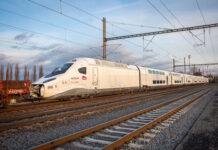


















On Wednesday, SNCF and Alstom presented their first innovation partnershipThis multi-disciplinary team of around twenty people will be open to the outside world. This multi-disciplinary team of around twenty people will be open to the outside world, and intends to rely on experts, guests, and collaborations with engineering and design schools, as well as start-ups. The cooperation unit is now focusing on a specific objective: 2022, the date when the new version of the TGV is due to enter service. Rachel Picard, Managing Director of Voyages SNCF, and Jean-Baptiste Eymeoud, Managing Director of Alstom France, talk about " a breakthrough in terms of competitiveness "and a new technological, commercial and industrial strategy for high-speed rail ".
In concrete terms, this new-generation TGV will reduce acquisition and operating costs. Those in charge of the project are counting on a reduction of 20%, which will be achieved in particular through a increased train capacity. This should reach 20%, according to the heads of Alstom and SNCF. This TGV of the future must also significantly reduce its energy consumption, by 25%. Of course, the passenger is also at the heart of the project, and should benefit from improved service, comfort and on-board connectivity.
It remains to be defined what these various measures will entail in concrete terms. " updates " of the new generation TGV. This is the aim of the first phase of the project, which was launched on 7 September and will run until the end of 2017, with the "joint definition and specification of the new TGV". This will be followed by the "detailed design, industrialisation and certification" phase, which is expected to last four years. This will culminate in the production and commercial launch of the new rolling stock in 2022. All in all, those in charge of the project estimate that 4000 jobs will be created in the French rail industry.