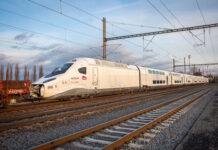


















Launched in 2013 with "a start-up spirit according to SNCFthe TGV Ouigo has enjoyed a string of successes, culminating in currently accounts for almost 25% of the French high-speed rail market. Originally linking Marseille and Montpellier to TGV stations in the Ile-de-France region (Massy, Roissy-CDG, Marne-la-Vallée), the pink trains have been making their way into the capital's stations since 2017, serving sixty destinations in France. They also offer international services in Spain until theItaly in 2026. Some 110 million passengers travelled on Ouigo, a sharp increase compared to the previous year. 50 million by 2019 before the pandemic.
" With fares starting from €9, Ouigo has helped tobringing more customers onto the railways because 50% would not have taken the train without this offer and 20% would not have travelled at all "says Alain Krakovitch, Director of TGV-Intercités for the SNCF. And he believes that Ouigo has not cannibalised TGV Inoui: " Although 55 million of these passengers came from Inoui, these TGVs have maintained high occupancy rates. More people travel by TGV in the end. So, every time we open a Ouigo line, there are 20% more rail customers on this new route. ". L'ecological aspect is obviously also highlighted. " As well as democratising high-speed rail travel, our high-capacity trains - the equivalent of 5 Airbus A320s - with high occupancy rates - 80% on weekdays and 90% at weekends - generate extremely low CO2 emissions. "he insists.
50 more comfortable and equipped Ouigo trains
Given this success, the SNCF has decided to push its advantage by doubling the number of passengers carried annually by Ouigo by 2030. Let 50 million passengers in 2030 compared to 24 million in 2022 over a global high-speed market which SNCF hopes will grow to 230 million customers compared with 140 million last year. This growth will be achieved primarily through the opening of new routes, such as Brest, Quimper, Perpignan, La Rochelle, Bourg-Saint-Maurice, etc., but also through an increase in the number of passengers, which will reach the 50 TGV trains by 2026 compared with 38 at present. The new trains will also have more capacity (653 seats compared with 634), as SNCF has decided to convert TGV Inoui trains that are more than 15 years old. An opportunity to rejuvenate the product with a more modern train design, more comfortable seats, more electrical sockets or USB port for each seatThere will also be more storage space for luggage and bike racks. Not to mention less flashy colours inside the carriages. " We plan to have 40 renovated trainsets out of the 50 in operation by the end of the year. "explains Jérôme Laffon, Director of Ouigo.
Keeping prices attractive at all costs
These SNCF promises that investments will be made without any significant impact on faresHowever, it did not reveal the average price of a Ouigo ticket. " One ticket in two is sold for less than €25 and only 15% of passengers pay more than €50 for their journey "Nevertheless, Alain Krakovitch conceded that ". the maximum price has been reduced from €115 to €99€ ". Tight prices that SNCF is achieving thanks to more passengers per train, but also thanks to equipment maintenance carried out at night and which, above all, runs more, accomplishing more. 700,000 km per year double the capacity of a conventional Inoui TGV train. The most economical offer, Ouigo Train Classique, on the Paris-Nantes and Paris-Lyon routes, on the other hand, has yet to confirm its results despite 1.3 million passengers. " We need to complete the two-year trial before taking a decision. "he believes.
Services that could appeal to Pro customers
The business travellers would represent 10% of Ouigo customersThis is mainly made up of young people (25%) and families (17%). " Above all, Pro passengers are looking for flexibility and, therefore, lower prices. frequencies which is not always the case for Ouigo "says the director of TGV-Intercités. Visit Ouigo Plus package integrating against 9€ extra baggage, choice of seat, Wifi or even a priority access to the train, but also the fact of encouraging correspondence between the Ouigo TGVs and the new, more comfortable trains could nevertheless attract more business travellers in the future, particularly self-employed people and small businesses. They could also be attracted by the latest exchange innovations. As a Ouigo ticket is non-refundable, the carrier has initiated Ouigoswapa exchange platform allowing you to try and resell it and receive 80% of its value in vouchers. " Some 35,000 tickets have already been resold in this way, the equivalent of 28 train sets. "Jérôme Laffon is delighted. L'Flex option €9 The purchase of Ouigo Flex also means lower exchange costs (€19 without Ouigo Flex). Here too, 5,000 Flex options have been sold since it was introduced on 12 April. " These options allow everyone to build your trip à la cartesays Jérôme Laffon. Half of customers take options. The choice of seat is made by 30% of purchasers and Ouigo Plus adopted by 20%. ". " Unlike air travel, however, Ouigo's business model is not based on the sale of these options. "concludes Alain Krakovitch, satisfied that Ouigo's profits will cover its investments.