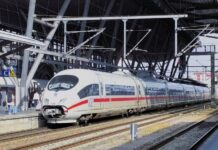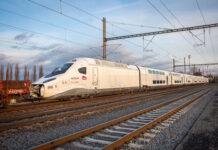
















There was a big crowd this morning on platform 5 of the Gare de Lyon to attend the presentation of the interior fittings of the future TGV M. This fifth-generation TGV is taking longer and longer to deliver, however, as it is expected to enter commercial service at the beginning of 2026, two years behind schedule. The tests for its certification began in December 2022. The delays seem to be linked to braking problems that require adaptations and new test campaigns, which will have to be carried out on the French network while the current commercial TGVs are in service.
From the 5 already assembled trainsets used for these tests, SNCF hopes to be able to havea dozen TGV M high-speed trains by early 2026 which will begin their life on the Paris-Lyon-Mediterranean route. With their additional carriages (i.e. 20% more seats), these trains should more or less compensate for the Inoui TGVs to switch to the Ouigo banner. " This TGV will be our strategic asset in the face of competition and in response to our 15% increase in services over the next ten years." says Christophe Fanichet, CEO of SNCF Voyageurs. " Its modularity will enable us to respond to all our markets, with more second- or first-class cars depending on the situation." . This TGV will also provide connections between France and Italy.
A space adapted to people with reduced mobility
" This TGV will revolutionise travel and set the benchmark for high-speed trains for decades to come." stresses Christophe Fanichet, who is highlighting the 400 industrial and technological innovations that have gone into this project, which has been co-constructed with Alstom since 2016. " The group has invested 4 billion euros for the order of the first 115 trains, using Voyageurs SNCF's own funds and profits" . New features include improved access for PRM passengers, with the lower section of one of the carriages able to accommodate up to 5 wheelchair users, fully independent boarding thanks to a lifting platform and an adapted toilet area. Passengers who are unable to move about will be able to use a catering service instead, using the TGV Inoui portal.
A more zen and luminous TGV
Climbing for the first time in the TGV MThe passenger will first be struck by the enhanced luminosity of the white walls and very long windows. Then there's the disappearance of the sliding doors that used to separate each passenger car. This improvement has been made possible by the significant reduction in external rolling noise. More space has also been given over to the luggage area at the entrance, in a very raw, industrial-style layout that stands out from the rest of the design of the carriages dreamt up by Arep (a subsidiary of Gares & Connexions) and the Japanese firm Nendo. They wanted to offer a simple, uncluttered design, with comfort as the main focus. This more open décor should also encourage passengers to get moving during the journey, and in particular to visit the bar car, renamed Le Bistro. Designers must take into account longer journeys, with the TGV going further and further into Europe as a result of passengers' growing appetite for rail travel.
Red in 1st class and blue in 2nd class

A gradient of red to burgundy has been chosen for the woollen fabrics of the 1st class seats, immediately reminiscent of the colours of theex-Thalys. More comfortable, the new seat is 5 cm wider in this class, with an enhanced electric recline, a generous tray table and a height-adjustable headrest. However, it is not no more putting a bag in the hanging rack above you, as this has disappeared. Only the clothes rack running along the wall has been retained in this future TGV. Bags will have to be slipped under the seat. Finally, there is a full armrest for aisle seats to prevent personal items from falling out.
In the second, a shade of blue awaits passengers, who will each benefit from a reading light, a mini-tablet and an electrical socket. Above all, they will have an extra 5 cm to stretch out their legs or stow their bags in the absence of the overhead luggage rack. The yellow lamp on the squares and facing duo seats is already set to become iconic.


The bar becomes a self-service area

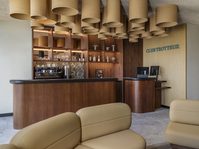
But the great revolution will be le Bistro which is now spread over two levels linked by a staircase, with a self-service sales area at the bottom equipped with fridges like those in supermarkets, two automatic payment terminals, two machines for hot drinks and two microwaves for reheating food. A barista will be on hand to help customers and prevent them from leaving without paying. We're already wishing him good luck! On the first floor, customers will be able to choose from 28 seats, which will also be very stylish. The SNCF will be taking advantage of the opportunity to offer a new menu, renewed three times a year, featuring French products and dishes. " It will be difficult to do anything worse than what SNCF is currently offering." said Philippe Tabarot, the French Transport Minister, in his speech. It was a rather unkind remark, despite the fact that the SNCF has made great strides in recent years in the field of on-board catering, notably through its partnership with chef Thierry Marx, with whom the SNCF has a long-standing relationship. collaboration has just come to an end.