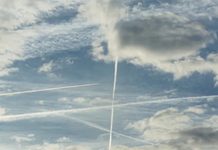














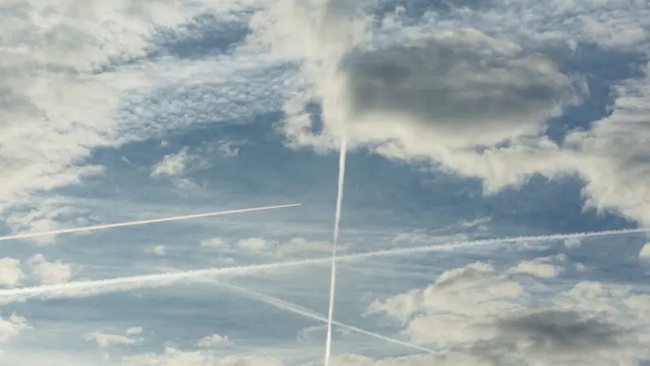
" An unrecognised subject, but one that is beginning to be brought to light » : Christine Arrighi, Green MP for Haute-Garonne and co-chair of the Aeronautics and Space group in the National Assembly, sums up everything there is to know about condensation trails produced by aviation. Indeed, while sustainable fuels and new generations of aircraft have long been seen as the main drivers of the aviation sector's energy transition, those long white lines streaking across the sky in the wake of aeroplanes, pretty though they may be, nonetheless have a major impact on the sector's ecological footprint.
Long neglected, they even contribute as much as carbon emissions to global warming. «Non-CO2 »which effectively double the climate impact of aviation, generally estimated at between 5% and 6%. But this impact could be limited. According to the environmental NGO Transport & Environment (T&E), halving the climate warming caused by condensation trails, at current traffic levels, would indeed avoid between 67 and 225 MtCO2per year.
Because contrails are nothing other than artificial clouds, known scientifically as Cirrus homogenitus, that is to say, man-made. Conspiracists who imagine they see a spraying of chemical or biological products may be displeased, but these clouds are born from water droplets combining the vapour coming out of engines with combustion residues, soot in particular. And, like any cloud, they cool the Earth by reflecting sunlight back into space, but also warm the atmosphere by trapping the Earth's heat. And even more so at night, sun permitting.
Consequently, depending on the time of day or the weather, some trails can disappear in a few minutes, with a negligible climate impact. On the other hand, if these are generated under certain conditions, at very high altitude in air laden with moisture, the water droplets turn into ice crystals. And consequently, into ice clouds, or even fields of ice clouds as they accumulate. For a maximum greenhouse effect.
3% of flights, 80% of global warming
Therefore, avoiding flying through these ice-supersaturated regions (ISSRs) would have a positive impact on global warming. While these ultra-cold and humid zones mainly occur in the skies of the Northern Hemisphere, particularly in Europe, the United States, or over the Atlantic -- unlike China or India where the air is drier -- only 3 % of flights cause 80 % of the warming linked to condensation trails. That is to say, largely night flights during the winter months. « On a given flight, a contrail can represent several tens of tonnes of CO2 equivalent2 », explained Nicolas Bellouin, director of the Climaviation research project and holder of the Aviation and Climate Chair at Sorbonne University, during a conference on the subject at the National Assembly.
" This phenomenon has been known by scientists for a long time. However, faced with uncertainties regarding the measurement of its impact, many have swept the subject under the carpet to talk only about CO2 », remarks Christine Arrighi. But as scientific understanding advances – even though areas still need clarification –, burying one's head in the sand is no longer acceptable in view of the potential gains. According to a report by Klima Consulting, commissioned by T&E and written by Olivier Boucher, a former IPCC scientist, implementing measures to avoid condensation trails – with longer flights avoiding ISSRs vertically or laterally – would free up 3 to 5 percentage points of the 2025-2050 global thermal budget under a 2°C pathway.
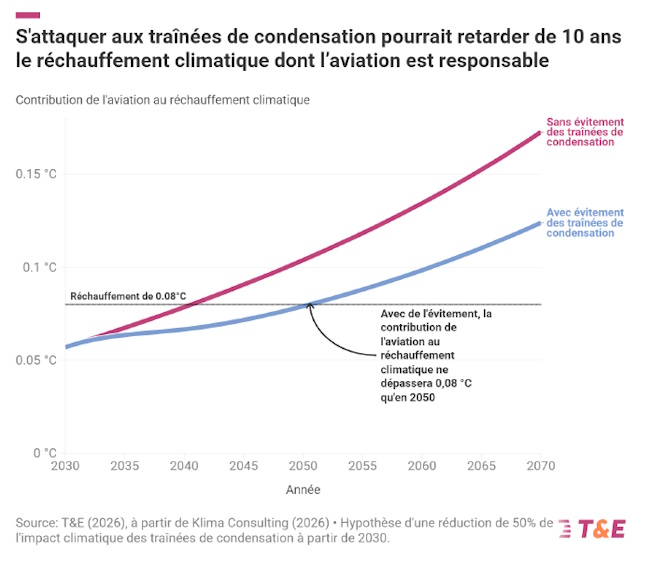
In other words, by embarking on a policy of avoidance for the most impactful flights in 2030, it would delay aviation-related global warming by ten years. A tiny detail – the equivalent of 0.08 °C in 2050 rather than 2040 – but one that makes a big difference. Moreover, there is a genuine collective awareness of this delayed effect. In 2025, the European Commission thus launched mandatory reporting of the non-CO2 effects of the aviation sector. And more recently, as part of the revision of the European carbon market, she proposed free allowances for airlines that use contrail prediction software based on the location of ice-supersaturated regions.
Companies are also beginning to explore these avoidance strategies. Between last February and April, Air France conducted tests in order to deepen its understanding of the formation conditions of contrails the most warming ones, and to evaluate in parallel, under real conditions, the feasibility of trajectory adjustments. Conducted in collaboration with two French start-ups, Estuaire and Klima, this trial covered nearly 4,300 flights crossing the North Atlantic. Based on the analyses carried out, particularly regarding weather conditions, more than a hundred flights had their routes modified, avoiding the equivalent of 22,000 tonnes of CO2 and reducing the climate impact linked to condensation trails by 8 %.
Better still, 130 flights were rerouted for a net benefit: a 57 % reduction in the climate impact of contrails and a 36 % reduction in the overall climate impact.« This test campaign constitutes an important step in evaluating the levers for reducing the climate impact of condensation trails », commented Vincent Etchebehere, Air France's sustainable development director, during the recent announcement of these results « encouraging »and which will be shared as part of ongoing scientific and European work.
Recently, another trial was announced, Operation Blue Skies, supported by the British government, the University of Cambridge, as well as the Shanwick air traffic control centre and Google UK, notably for AI-based forecasting models. These tests will focus on flights across the North Atlantic during the winters of 2026-2027 and 2027-2028, when air traffic is reduced.
The means to match those ambitions
Because there is often a long way between theory and practice and tackling condensation trails fully takes time, with a ramp-up anticipated by 2032. It also takes money. A study commissioned by T&E from the consultancy to70 estimates the funding required to carry out these various tests on a European scale at 100 million euros in order to bring the entire sector to a sufficient level of maturity to avoid condensation trails on an industrial scale. « €100 million compared with the cost of an SAF production plant project, which can range from one to two billion », highlights Jérôme du Boucher, Deputy Director of Aviation at T&E France. To this end, most stakeholders are calling on national and European authorities to support the effort underway, while some upcoming projects are not yet funded or have been put on hold for budgetary reasons.
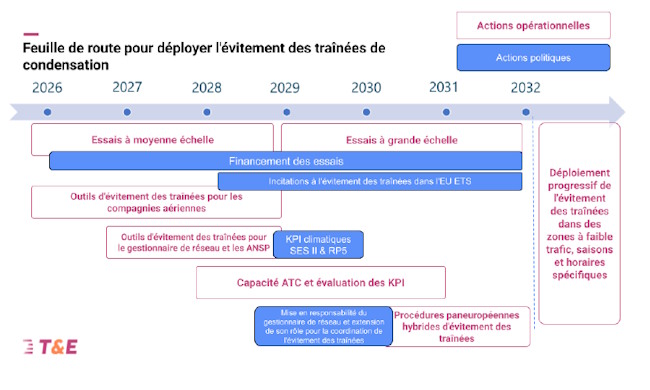
One thing is for sure, the road ahead is still long and all these experiments will not be too many to, on the one hand, refine scientific studies and overcome the resistance of sceptics and, on the other hand, overcome obstacles to tackle the contrails on a large scale, particularly in a space as dense as European airspace. Among these, the deployment of planning tools for airlines and air traffic control is one, as is enhancing the reliability of forecasts for contrail-prone areas. But one other thing is certain, however: for a business traveller mindful of their carbon footprint, it is still best to avoid Paris–New York night flights in the dead of winter for a while yet.