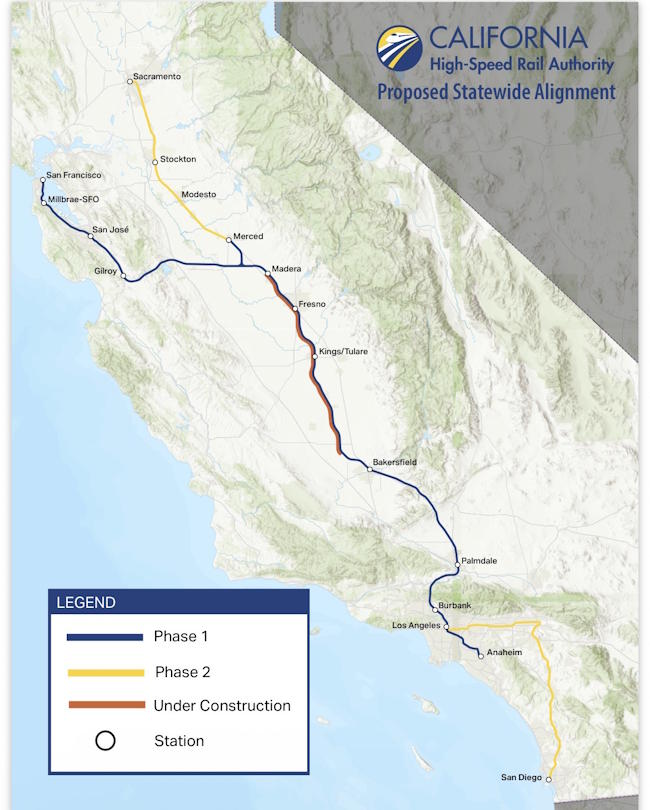
The California high-speed rail project is attracting more interest than ever from French railway specialist groups. Brought together within a joint venture integrated into the Momentum Alliance Partners consortium, Keolis and SNCF Voyageurs have indeed just concluded a co-development agreement with the California High-Speed Authority, which is responsible for the construction of the California high-speed rail. More specifically, SNCF Voyageurs and Keolis will pool their expertise in the operation and maintenance of railway networks to accelerate the project's progress, but also to find private and/or public-private investment for the extension of this high-speed line currently under construction in the Central Valley, between Merced and Bakersfield.
Keolis is already well established in the United States, where this SNCF subsidiary is the leading operator of commuter trains. Other French companies are also present in Momentum Alliance Partners, such as Systra, which specialises in the construction of high-speed lines, conventional rail lines, or tramways, but also Arup, which is already involved in the Project Alto the Canadian HSR between Toronto and Quebec City via Montreal.
The SNCF group is pushing its pawns in North America
While the inauguration of the first 192 km section is not expected before 2032-2033, the agreement, with a maximum duration of 30 months, aims to study the possibilities for extending the Californian high-speed rail. The consortium will assess infrastructure sequencing, delivery models, funding strategies, operating concepts, and opportunities for private sector involvement in future extension sections. ", the two partners specify in a joint statement."
Christophe Fanichet, the CEO of SNCF Voyageurs, believes that the choice of the California High-Speed Authority constitutes « a key step in deploying our expertise internationally. Our 40 years of high-speed rail know-how is thus recognised for developing a high-quality rail service in the United States, which will meet the needs and transformation of traveller mobility, while contributing to the development of sustainable mobility. This contract is the second for the SNCF group in North America after the one secured in Alto where Keolis and SNCF Voyageurs are already partners, this time via the Cadence consortium.
The 600 km from San Francisco to Los Angeles in 2h40
A colossal undertaking, the first high-speed line in the United States aims to connect San Francisco to Los Angeles in 2 hours and 40 minutes by 2045, with possible extensions to Sacramento in the north of the state and San Diego in the south. The California High-Speed Authority estimates that more than 90 million passengers per year should use this roughly 1100-kilometre network once its construction is complete.
The Trump administration, however, is fiercely opposed to this project, which it criticises at every opportunity, and in 2025 it cancelled a federal grant of 4 billion dollars for it. Launched in 2008, the project has indeed suffered significant delays; the initial schedule had envisaged completion of the central section by 2020 at a cost of $33 billion. This budget, which was subsequently increased to 89 Md$, is now estimated at between 113 and 128 Md$.