














The horizon is tinted red for the French air sector. Last August, during the peak summer season, passenger traffic declined by 1 % vs August 2025, and even more so for international flights (-1.4 %) and for the Paris airports (-3.5 %). The end of summer only follows a trend observed since the beginning of the year with a drop in traffic of -0.5% over the cumulative figures for the first eight months of the current year. This is only a level slightly higher than that of 2019 (+1.0 %), while domestic traffic falls by -21 % compared to pre-covid times.
Even though the latest figures published by the International Air Transport Association (IATA) show that demand only increased by +0.7% in Europe, compared to a global increase of +2.1%, « European traffic continues to grow, while French passenger traffic continues to decline »", notes Rafael Schwartzman, Regional Vice President Europe at IATA.
Less flights, less choice
And this « dropping out »Noted by Pascal de Izaguirre, President of the National Federation of Aviation and its Professions (FNAM), this increase no longer only concerns demand: the supply is also increasing. At 100% in 2019, the planned capacity will reach 111 in the European average in 2026, compared to only 102.1 in France. This is a difference of almost nine points, or the same number of seats and frequencies less for business travelers.
Although its level is among the highest on the continent, the number of airlines operating in the hexagon has decreased by 6% since the middle of the previous decade, while Italy and Spain have experienced growth of around 15% in the same period, and even more in Turkey (+29%).
For the FNAM, the reason for the decline in French air travel cannot be far searched: the continuous increase in taxation that produces « announced effects »Pascal de Izaguirre notes," The TSBA's revenues are expected to increase by +194 % in 2026 compared to 2024 and % by +407 compared to 2019, resulting in a reduced attractiveness for flights from France. And this, without counting an additional increase of nearly 250 M€ planned by the 2027 Finance Bill through new taxes on airport infrastructure and security fees.
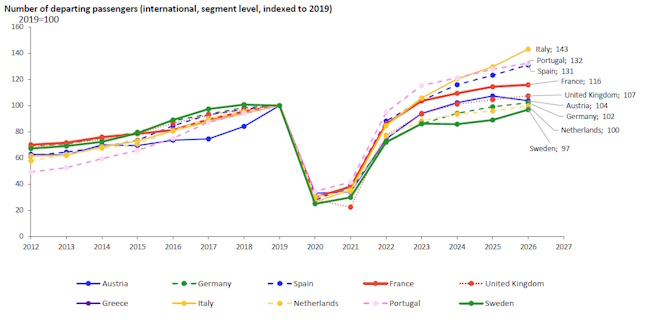
In contrast, the FNAM likes to point to the example of Sweden, showing that the elimination of this tax in mid-2025 had the effect of boosting growth, going from a drop in traffic of 3.4% in the second quarter of 2025 to an expected increase of +8.9% in the last quarter of 2026. As if to highlight the counterproductive effect on public finances of the tripling of the TSBA.‘ The FNAM commissioned calculations by consulting firms showing a loss of 750 million in tax revenue in 2025 and undoubtedly 1.6 billion for 2026. »That's a good idea," remarks Pascal de Izaguirre.
This " escalation of costs » The president of the FNAM, who is also CEO of Corsair, is concerned, especially given the surge in the price of kerosene since the beginning of the conflict in the Middle East. As a result of the closure of the Strait of Hormuz, jet fuel skyrocketed from 750 $ tons to 1500$ at the height of the crisis, without ever returning to its previous level since then. In September, it traded at 1550 $ tons, and a little more in October. Therefore, while airline revenues are increasing, their margins have shrunk to just 2%. A low not seen since the covid. ».
Kerosene has doubled, tickets have hardly moved
" We know how to mitigate short-term crises, but the real issue is that this one is of exceptional magnitude and that it is lasting. »This sharp increase has been offset by very limited price increases by airlines, for fear of weakening demand and maintaining competitiveness against competition from other airlines," according to Pascal de Izaguirre. According to the DGAC IPTAP index, fares from France have actually increased by only +2.2 % over the first eight months of the year.
While jet fuel normally accounts for a quarter of airlines’ costs, its weight has now risen to 40-45%. In this context, «Cover policies have served their purpose, but their effectiveness is eroding as these mechanisms come to an end. And today, even the largest companies no longer cover themselves against prohibitive prices. »That, no doubt, will have an impact on ticket prices next year," he points out. The latest EPSA barometer also indicated inflation % in France of between 4.2 % and 4.5, with sustained demand adding to the effect of fuel prices.
To overcome these difficult times, the FNAM calls on the public authorities to take measures, notably to support the supply of kerosene – « This was done well, and we have no concerns at the moment. », specifies the president of the FNAM – , but also to facilitate the adaptation of flight schedules through a moratorium on the use of slots and the principle of «use it or lose it». « This issue has not progressed at the European level, but not flying the flights that are switching to red is another solution than increasing prices for the airlines’ finances. "explains Pascal de Izaguirre.
Without this framework, is it a surprise to see the FNAM add its flagship to its list of demands? In addition to cash assistance or the possibility of obtaining special public funding for the companies most vulnerable to the current crisis, the air transport federation is putting on the table a temporary suspension of the air ETS and mandatory compensation for domestic flights.« While kerosene is more expensive in Europe than elsewhere, the ETS involves a cost increase of 272 euros per tonne for an intra-European flight. To this is added 100 euros more for a domestic flight in France, Pascal de Izaguirre counts them. We are asking for a suspension during the crisis until oil returns to an acceptable level.. »