
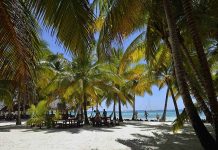
















"I was born in New Zealand. Over there, you grow up in Pakeha, the Maori word for people of Anglo-Saxon or European origin. Very early on, because of the remoteness of the country, New Zealanders, like Australians, travelled to discover the world. Even as a child, I had the intuition that I was going to live in Europe, a necessary step towards self-knowledge. Even if, in New Zealand, you grow up surrounded by breathtaking nature, with fjords, mountain pastures, black sand beaches dozens of kilometres long on the edge of the Pacific, flora and fauna unique in the world and subtropical forests that smell of undergrowth.
Even though I've been living in Europe since 1980, New Zealand remains a secret garden for me, a twenty-six hour flight from Paris. Few journeys these days require as much physical and sensory adaptation, with the possible exception of an expedition to Antarctica... Even at the age of 15, I knew I had to go abroad. I was given this opportunity when I went to New Caledonia to learn French in immersion. It was an obvious choice for me. In 1980, thanks to a grant from the French government, I was able to make my European dream come true. I headed for Paris, with three stops en route, in India, Dubai and Rome.
I travel a lot for my work, first of all to the major international fairs - those in Basel, New York, London, Hong Kong, Miami, Sao Paulo and Mexico... But above all I try to meet gallery owners, whether in Los Angeles, Chicago, Rio or Bogota, not to mention New Delhi, Mumbai, Tokyo, Shanghai, Beijing, Seoul and Beirut, because there are some really interesting new art scenes out there now.
I also travel privately. For example, in 1984 I went to Madagascar with my friend. At the time, there wasn't much tourist infrastructure. We arrived in Tananarive and took the train to Tamatave, on the east coast, where we ended up in a boui-boui. There, a young man who spoke French offered to take us on a tour of the hinterland. We went trekking for three weeks in the tropical forests on the high plateaux, in places where the local population had never seen tourists! The memory of that extraordinary adventure still moves me.
There are other places that have fascinated me, such as the Inhotim estate in Belo Horizonte, Brazil. It's a huge botanical park with an open-air museum, a folly created by iron ore magnate Bernado Paz. Monumental sculptures by today's leading visual artists - Olafur Eliasson, Matthew Barney, Paul McCarthy and Yayoi Kusama to name but a few - can be seen in pavilions dedicated to them. One of my next destinations will be Japan, for the islands of Naoshima and Teshima, places dedicated to contemporary creation. Soichiro Fukutake, the patron of the arts, has created a museum and an open-air gallery featuring works by Christian Boltanski, James Turell and Bruce Naumann.
On the other hand, when I'm on holiday, I like to be somewhere quiet and still. This summer, for example, I was staying with friends on the island of Milos, in Greece, where I was able to recharge my batteries in an idyllic and wild setting, rare in Europe. When I returned to Paris, one of the most beautiful cities in the world, I was once again dazzled and overwhelmed, as I am every time I come back. Paris has never disappointed me. It's an illustration of the eternal 'going and coming back'.
Interview by Jean-Emmanuel Richomme