












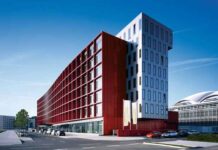



The Olympic Games, which will take place from 27 July to 12 August 2012, will not just be an occasion for great sporting encounters. They will also give rise to a real upheaval, a rush towards East London. After the alternative districts of Shore ditch and Spitalfields began to reshape the creative face of London in recent years, and the Canary Wharf business centre finally came into its own, the organisation of the Olympic Games is kicking things off again. A veritable process of regeneration, accelerated and on a grand scale, has been set in motion.
In all, £11 billion, or more than €16 billion, will be invested between 2007 and 2017. Over the same period, net spin-offs from tourism are estimated at around £1.5 billion - or more than €2 billion - according to London&Partners, the city's representative office. Of course, the Thames Gateway project, within which the Olympic site is located, had already been planned to become the largest urban redevelopment site in Europe, stretching 70 km eastwards from the heart of London. "If it had been planned anyway, the regeneration of these eastern districts would have taken thirty years instead of five".enthuses Patricia Holmes, consultant for the redevelopment of the London East Side. From The View, a brand-new building still standing alone in the middle of warehouses, you can see the progress of work on the Olympic site: the stadium, the aquatic centre, the velodrome, as well as numerous apartment blocks. Developing this part of the city will attract new investment," says the consultant, "because London's future is definitely in the East.
The future of this vast area of industrial wasteland, in the middle of which the Queen Elizabeth Olympic Park is being developed, has already been mapped out, entrusted since 2009 to the Olympic Parc Legacy Company (OPLC), which is in charge of redeveloping the site after the Olympic Games. The OPLC's premises, in the Stratford district and close to renovated former warehouses already occupied by young, tie-less entrepreneurs, offer a glimpse of what East London will soon be like. "The regeneration was of course planned for the Olympics, but it is a development plan that extends over twenty years, until 2030, with many short and long-term projects."says Rosanna Lawes, Development Director of the OPLC. The Olympic Park, which will close temporarily after the Games, will reopen gradually from spring 2013, and will be readapted for its new functions. Over the next twenty years, London's population is set to grow from nearly 7.2 million to more than 8 million. And East London is proving to be the real solution to this demographic growth. As well as becoming a real place to live.
"We want to create a new neighbourhood, in and around what will be the largest park ever designed since the Victorian era".says Rosanna Lawes. The legacy of the Olympic Games should therefore be of interest to Londoners in search of living space and cultural life, but also to international travellers. "As owners, we intend to bring in businesses and extend the creative atmosphere of Shoreditch."says the Development Director. "What will make all the difference to other new areas of London, like Canary Wharf, is the transport infrastructure that will be there straight away and will link East London to the rest of the city in a very short time."she concludes.
Golden Triangle
Business travellers will be able to reach London's various nerve centres in just a few minutes from this hotel. "Golden Triangle which includes Stratford, Canary Wharf and Docklands. This means that the ExCel London conference centre and its new hotels will be just a stone's throw from London City airport, St Pancras station, the O2 conference centre, Westfield and the Olympic Park. Transport for London will be investing £6.3 billion (over €9 billion) to overhaul the urban network. The Victoria and Northern Lines will also undergo improvements, while the Jubilee Line will increase its traffic by more than 20 %. Visit "Thames Clippers will allow travel on the Thames with the Oyster Card, as on the Underground, and will offer key stops such as Westminster and Canary Wharf.
The many canals to the east will now be navigable. And the Docklands Light Railway (DLR) will provide connections to the O2 and Excel conference centres. But the big project, on which work began this summer, is a cable car over the River Thames that will provide an environmentally-friendly link between Greenwich and the O2 conference centre, ExCeL London and the Royal Victoria Docks. The project, which is dear to the heart of London Mayor Boris Johnson, will, in his words "glide serenely over the Thames for a sublime flight over the city". The cable car will not only be an efficient way of crossing the river in just five minutes, but will also optimise the regeneration of East London. In addition, Crossrail, an RER linking the West and East of the city, is due to start operating in 2018.
Direction East End
The aim is for business travellers, visitors and Londoners alike to spontaneously opt for East London, and not just the city centre. In fact, hotel projects in this part of the capital already abound; and the "Golden Triangle Paul Alexan drou, Executive Director of the Story advertising agency, explains his decision to move his offices there in order to position himself in a stimulating environment. These eastern districts are becoming what is already being called London's Silicon Valley," he notes. As our work involves the use of digital elements, we can take advantage of the proximity of companies focused on high-tech businesses such as Google or Facebook."
Among the big names, Siemens is planning to build an iconic £30 million building to showcase the latest and greenest technologies to the public. The centre, located close to ExCeL and the Royal Docks, is expected to welcome an average of 100,000 visitors a year. "It's important to be close to the companies that determine the way we communicate today".concludes Paul Alexandrou. For Story, as for many others, it's an address that makes the eyes of talented people shine as much as those of their clients...
 J.O.: A real driver for urban redevelopment
The future of the Olympic site will not only be devoted to leisure activities, but will also become a mecca for contemporary art and architecture, with the bold Indian sculptor and visual artist Anish Kapoor being commissioned to design an observation platform, the Orbit, from which visitors will be able to admire the new East London. Another example is the sublime Aquatic Centre designed by Zaha Hadid, the famous British architect. A tourist destination, of course, but the park and its surroundings will also be a real place to live and do business. In all, 8,000 homes will be built in the refurbished Olympic Village from 2014, along with shops and offices.
The million square feet, or more than 90,000 m2, of the "press village which will welcome 20,000 journalists during the summer of 2012, will be redeveloped for commercial and residential use. But there's no need to wait until after the Olympic Games to see the upheavals taking place in the area. From this autumn, the Westfield Shopping Centre and its 306 shops, Europe's largest shopping mall, will open close to the Olympic Park: a symbolic first step and a harbinger of things to come...
Special report - London's great east: challenges for a real future
Hotels - Openings à l'Anglaise
- Olympic Games - East London in the starting blocks
London: address book


