




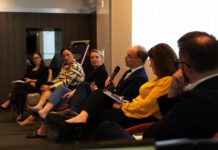












As it has every year for the past 18 years, the Univ'AirPlus event marked the return of the business travel world after the summer break. Held on 29 August at the Polpo bargeThis traditional event, held in Levallois, brought together travel managers, buyers and finance professionals for a large number of meetings and to visit the stands of the event's various partners, all players in the payment ecosystem.
As well as the networking opportunities, the event also offered plenty of food for thought. After asking the question in 2022 of whether or not we should travel to protect the planet, and then last year of whether the company needed meaning to be successful, it was time to ask the question: "What does the company need to be successful? the place of human beings in the face of the rise of artificial intelligence on the table. Will man be slowly but surely replaced by machine? Fantasy or reality? What fears and hopes does AI raise when, according to PWC, the technology could affect 30% of the global workforce by 2030?
"The company of tomorrow, with or without us": three personalities each tackled this theme in their own way: economist Pierre Bentata and Fanny Parise, research director and anthropologist, and philosopher Raphaël Enthoven. " Artificial intelligence is a major revolution which will pose considerable problems for a number of professions and disciplines" for Raphaël Enthoven, who makes a complete distinction between the human brain and the "human brain". silicon brain" . A revolution, according to Pierre Bentata, " of the order of the democratisation of writing or the industrial revolution, the advent of a universal technology whose changes, as is often the case, are overestimated in the short term but underestimated in the long term" .
The presentations enabled Univ'AirPlus participants to walk this fine line between utopia and reality, between false fears and real progress. There is a consensus that generative AI will increase productivity and have an impact on jobs with repetitive tasks. " Back office and mid-management jobs are the target of AI" says Pierre Bentata, while for Fanny Parise, " it's not so much jobs that will disappear as skills that will have to be reinvented" . " Generative AI will not only accelerate the change in the way we perceive the world, it will also revolutionise the way we relate to our human skills." explains the anthropologist.

Technology assistant for low added-value tasks, coach, content aggregator: Fanny Parise plans to new interactions between man and machine. These relationships are tinged with animism, leading to the attribution of souls and intentions to non-human entities. In his position as "observer" the anthropologist is neither optimistic nor pessimistic about AI: " It is generating a positive dynamic, reviving an imagination of productivity, but raising the question of the place of technosolutionism in the face of the inevitable environmental impact of AI." .
" Regardless of the complexity, AI can replace tasks that come out of a method. It is only effective if it is given clear orders" says Pierre Bentata. For the economist, this implies the need for supervision and knowing how to use it properly. Because this technology paradoxically celebrates the revenge of the verb. " If you ask the AI questions in a language that is not coherent, problem. In contrast to clear thinking expressed in sophisticated language" .
Human brain vs. silicon brain
For the economist, human intelligence is not really comparable to AI, which gives an illusion of intelligence: " She excels at repetitive and technical tasksThis confirms what Yann Le Cun, one of the fathers of artificial intelligence, said when he said that generative AI is 50 times less intelligent than a four-year-old child." . Able to beat the greatest masters at the game of Go, but very poor when asked to do a charade: isn't the least of AI's advantages to " rethinking human intelligence" says Pierre Bentata?
Is the machine stronger than man? For Raphaël Enthoven, more than obvious : " Otherwise, it wouldn't have been invented." . " It makes up for our shortcomings, but it remains a machine" he adds. His confrontation with ChatGPT on the subject of the 2023 bac philo - Is happiness a matter of reason? - provided a clear example: 20/20 for the philosopher, barely average for the AI, " unable to set out a problem as required for a dissertation" .
" Accumulating data does not mean knowing how to thinkemphasises Raphaël Enthoven. You can accumulate as much data as you like, but you'll always be at the opposite end of the spectrum from what unites a being, the indivisibility of an individual. You can ape it, you can imitate it, but there's a process that no machine can reproduce" . Love, death, happy or sad passions...". It's all these unquantifiable feelings that we mobilise when we're looking for an issue. It is fear, confusion and the experience of being in the world that makes us think." .
From Pygmalion to The Matrix, from The Golem to The Terminator, human beings have never stopped staging the moment when machines would "take over". grand-replacer "according to Raphaël Enthoven, " where metal consciousness would replace our own" . " But the question is not so much when we will be replaced, as where does this old fear come from?" asks the philosopher.
Among the answers, Raphaël Enthoven evokes an almost animistic relationship with the machine - " the more we are enslaved to our iPhone, the more we imagine it to be alive and the more we can lend it devious intentions" . But, in this conviction that humanity might be capable of producing machines that think like it and take its place, he sees above all, not modesty, but a desire to take the lead. hubris : " The only one who has given his creatures the freedom to turn their backs on him is God. In the feeling that our machines are going to escape us and possess us, there is quite simply a divine fear. In a way, it's playing God." .