






















Same causes, same effects… Just as what happened during the Paris 2024 Olympics or the London Games, hoteliers' hopes for the World Cup could well be dashed, particularly in the business segment. Faced with soaring prices in anticipation of the event, combined with an increase in supply, demand is often lower than expected. " Let's be honest – no one had FIFA World Cup 2026 in their 2023 risk register. They should have. Summarise the latest report published at the end of May by FCM Consulting.
According to the business travel specialist, hotel rates in US host cities are around 50% higher than in the same period last year. The trend is even more pronounced in Mexico and Canada, with average rate increases of +114% and +92%. Prices could even triple in a destination such as Vancouver! In addition to this overall rise throughout the event, FCM Consulting logically anticipates peaks on match days, with, for example, a further increase of 31% in US host cities.
The result is that travel buyers who failed to plan ahead are more cautious than ever. And the expected occupancy rates are disappointing. The Mexican Hotel Association of Nuevo León estimates, for example, that occupancy rates on match days in Monterrey are limited to 60 per cent, far short of initial targets.
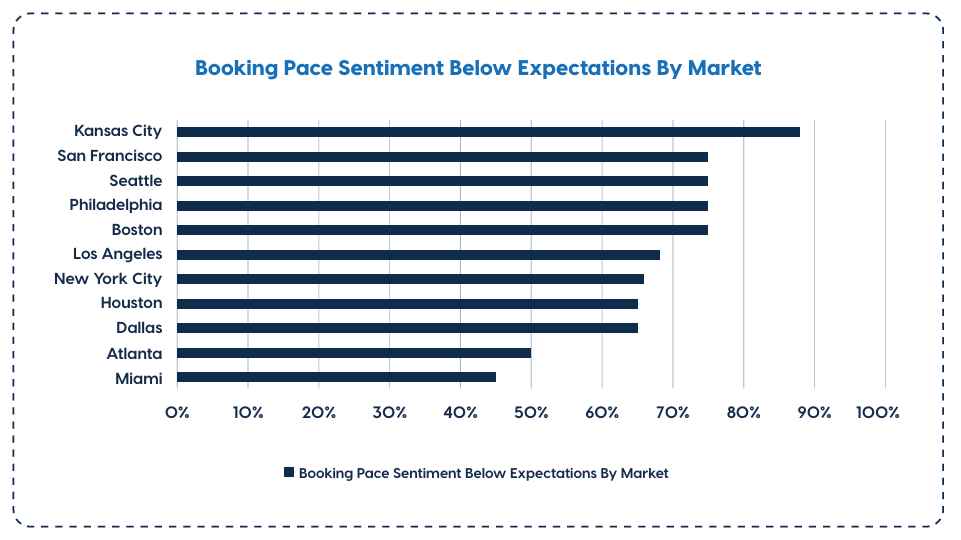
In the United States, the American Hotel & Lodging Association (AHLA) has also looked into the subject. In a study conducted in April, it estimates that " The expected economic fallout may not live up to expectations. Despite more than five million tickets sold, this demand has not yet translated into solid hotel bookings. Forecasts show that domestic travellers are outnumbering international visitors – an imbalance that threatens the overall economic impact the World Cup was meant to generate. » note the report's authors. For the association, eight out of ten hotels are seeing bookings fall short of initial forecasts.
But according to the American Hotel & Lodging Association – and other industry experts – pricing policy isn't solely responsible for the gap between objectives and reality. FIFA, which had booked rooms on a massive scale, proceeded with numerous cancellations: " FIFA's over-allocation of room blocks created an artificial demand signal that has since dissipated, with approximately half of respondents in host markets reporting significant room block releases. Many hotels indicate early booking signals overestimated actual demand. »The authors of the study note.« According to El Financiero, FIFA would have canceled 40%d reservations in Mexico. And the Greater Philadelphia Hotel Association estimates that 2,000 cancellations have been recorded in »Philly.".
Another brake on hotel bookings: the factor Trump. Even if he is not cited in the AHLA study, it points to " Visa barriers and broader geopolitical concerns who are significantly dampening international demand, according to nearly 70% of those surveyed ".
Nevertheless, the situation may not be as critical as these statistics might suggest. On the occasion of the presentation of the results on 6 May, Jen Mason, Marriott's Chief Financial Officer, stated: " We were expecting cancellations of FIFA room blocks for this type of event, and these had been factored into our forecasts. We expect the group occupancy rate for this type of event to be around 15% in Q1, compared with something like 40% in Q1 for the Super Bowl. We therefore remain optimistic about the opportunity this represents " And Jen Mason added: " Despite what you hear and read in the press, we remain confident in our estimate of a 30 to 35 basis point impact on global RevPAR growth this year. We have conducted thorough research before putting forward this figure. We have benchmarked ourselves against other major citywide events that we have experienced previously. ".
Furthermore, in its report Hotel outlook for the FIFA World Cup 2026, Amex GBT Consulting reminded us in May: « Despite current reports of low hotel booking rates, history teaches us something important: 70% of accommodation for previous World Cups was booked in the 30 days leading up to the matches. The outlook is therefore likely to remain volatile for some time yet ".
At Marriott, Jen Mason confirms: " Total revenue is progressing well for match days and remains in line with our expectations — even though there are obviously a lot of bookings still to be made, which is normal given where we are in this booking window and the fact that we don't yet know the exact matchups for the second half of the competition. ".
These anticipated last-minute bookings could be boosted by the ‘price adjustment’ observed by Lighthouse. According to a study published by this business platform for the travel and hospitality sectors, ‘Hotels are lowering their prices. Five of the seven cities in our panel have seen their average rates fall since October, with only Dallas showing sustained upward momentum. Across these five cities, the average rate drop is 8% Q3-Q4, led by New York with a 15% Q3-Q4 decline. New York remains the most expensive host city, but the average rate over the tournament period has fallen from 583 $ to 494 $.”
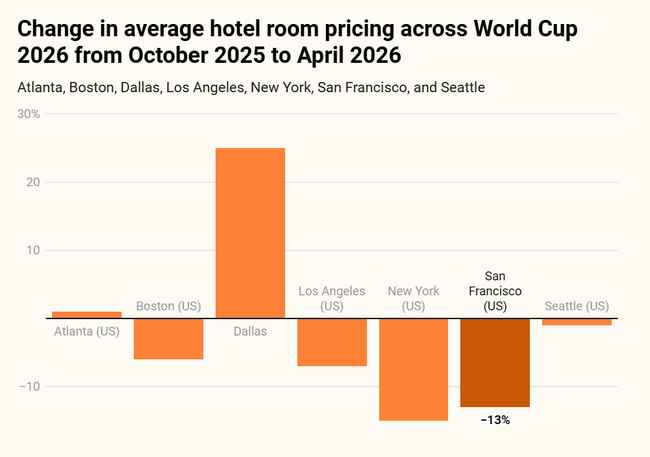
The authors of the Lighthouse report add: “ For major events, rate curves often invert as the date approaches, meaning a certain discount is expected. The real question is whether hotels are adjusting their prices aggressively enough, given such low booking levels and the hundreds or thousands of rooms re-entering the market after FIFA cancellations. ".
The business travel agency Amex GBT Therefore, I recommend business travellers and their companies remain vigilant: " As with any sporting or cultural event, the evolution of demand is dynamic and requires close monitoring. Your absolute priority is to ensure that you have effectively communicated any changes in travel policy to your travellers and that they remain well informed. ".
2026 World Cup
2026 World Cup, 2028 Olympics: Los Angeles strengthens its MICE bid
Reportage: Monterrey, when industry meets the football
Canada, the other MICE destination in North America
- World Cup: Hoteliers out of play?
World Cup: what are the hotels for the 48 teams?
J. Coker: "New York offers an unrivalled experience
Accor: a shared goal with Kylian Mbappé
Vancouver, the first station to welcome United States immigration services
