













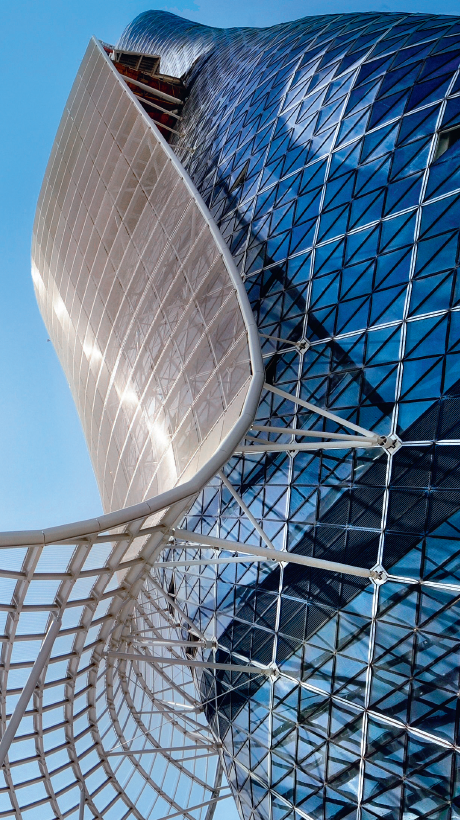
Hyatte Capital Gate (Abu Dhabi) - Cabinet RMJM. Since late 2011, Abu Dhabi has been home to its modern-day Leaning Tower of Pisa. Inclined at 18 degrees, the glass and steel skyscraper is home to an elegant Hyatt. In their desire for grandeur, emerging megacities are organising highly successful marriages between architecture and hotels.
Pritzker. The name is the stuff of dreams for architects and business travellers alike. It is the name of the founding family of the Hyatt hotel group, the same family that each year - through its foundation - awards the 'Nobel Prize' in architecture, the famous Pritzker Prize. The lucky winners have included Norman Foster, Franck Gehry, Zaha Hadid, Jean Nouvel and Renzo Piano. It's hardly surprising, then, that this group, which was born in Chicago - a model city for contemporary urban planning - has a special relationship with the most inventive builders. This was confirmed by the opening of the Park Hyatt New York at the end of last summer, a hotel housed at the top of the One57 tower designed by Christian de Portzamparc. A Pritzker prize-winner, of course.

The aura of the "starchitects
Today's clientele is not just sensitive to the striking design of a Philippe Starck or the fashionable label of a Lagerfeld. They are interested in both the substance and the form of the hotel, scrutinising the inventiveness of the building and the art of the welcome. Property investors have understood this. They do not hesitate to associate their projects with the talents of a 'starchitect', who brings his or her own aura to the project and thus ensures the profitability of these complexes, which combine offices, shopping malls, flats and five-star hotels. The proof is in Dubai, where the developer Omniyat is in the process of building a surprisingly shaped tower called The Opus, due to be completed in 2016. This sort of cube, hollowed out at its centre and designed by Zaha Hadid, will include luxury boutiques on the lower floors, offices in the middle and, to top it all off, a Me by Melia hotel and luxury penthouses. "The Opus is an extraordinary work of art, created by one of the world's most brilliant minds."explained Mahdi Amjad, CEO of Omniyat, when the project was announced. It will provide a first-class experience for hotel guests and residents of the long-stay flats."
While in Europe, the hotel industry calls on the best designers to transform historic buildings, in the capitals of emerging countries it opts instead for futuristic skylines. This is particularly the case in the Middle East, where nothing is ever too beautiful or too high. While we wait for the string of museums under development on Saadiyat Island, designed by Ando, Gehry, Hadid and Nouvel, Abu Dhabi has enriched its architectural heritage with striking buildings such as the Capital Gate Tower. This Pisa-style tower - but even more inclined! - designed by the RMJM agency, is the focus of intense business activity, with an elegant Hyatt, a high-tech conference centre and more than 10,000 m2 of office space. In the "defying the laws of nature" style, the Burj Khalifa tower in Dubai has gone even further. Designed by the renowned firm Skidmore, Owings and Merrill, the tallest man-made structure ever built reaches for the stars, with the sober chic of an Armani hotel in the sky.
Projects are also teeming in China, where every regional metropolis is dreaming of a new Pudong, like Shanghai's futuristic business district and its towers topped with luxury establishments. And, as in Shanghai, the developments underway will delight even the most architecturally demanding business travellers. The Dubai-based luxury brand Jumeirah has announced two highly ambitious projects, the first in Nanjing, in the new Hexi business district, and the second in Wuhan, in a multifunctional complex. The respective architects are Zaha Hadid and Foster & Partners...
Since hotel empires are above all built on stone, these close links with the best architects are hardly surprising. Nor very new. Even in their time, the tycoons of the sector had their own appointed builders. A close friend of the Pereire brothers, the developers of Haussmann's Paris, Alfred Armand designed the Grand Hôtel on Place de l'Opéra for them. Charles Mewes designed the Ritzes in Paris, London and Madrid, and Schultze & Weaver designed the Biltmore in Miami and the Pierre and Waldorf-Astoria in New York. All these names have faded from memory, unlike the places they created. Frank Lloyd Wright, on the other hand, remains associated with the legend of Tokyo's Imperial Hotel. Yet this symbol of Japan's openness to Western architecture no longer exists, having been demolished at the end of the 1960s and replaced by a more modern building.
Why is it so enduring here and forgotten there? Probably because Frank Lloyd Wright ushered in the Golden Age of town planners, that of the Corbusiers, the Mies Van der Rohe and, closer to home, the Peis and the Niemeyers. These avant-gardists entered museums - often building them, in fact - and at the same time entered the star system. This 'peoplisation' explains the current craze for architectural hotels. Experts in the field even have a name for it: the "Bilbao effect". With the opening of its Frank Gehry-designed Guggenheim Museum, the Basque city has shown the world that a strong architectural statement can make a mark on the tourist scene.

Futuristic icons
Couldn't the same be true of the hotel industry? With their emblematic lines, certain establishments symbolise their city in the eyes of the world. Designed by Moshe Shafdie, the Marina Bay Sands has become the futuristic emblem of Singapore, just as Dubai did with the Burj Al Arab. It's as if the Eiffel Tower and the Ritz had become one! Opened in Madrid in 2005, the Puerta America has taken this logic to the extreme, piling up Pritzker prizes on every floor. On the first floor, fluid rooms designed by Zaha Hadid, on the second a flexible environment designed by Norman Foster and so on up to the twelfth, with suites and a penthouse designed by Jean Nouvel, who also designed the façade. In all, 19 architecture and design firms have worked on the Puerta America cradle. "Even if it's not as central as some of the city's other hotels, it's where my husband and I wanted to stay, to experience this concentration of inventiveness from the inside and discover the work of these designers who know how to give soul to materials."says Salma Dioury, a lover of beautiful places and an architect by profession.
Big names always do well in hotel collections. They set the tone and guarantee glossy magazine pages. Me by Melia, the Spanish group's fashion brand, is counting on this publicity to raise its profile. Its London hotel, opened in 2013, is the first in the British capital to have been designed by Sir Norman Foster. In 2015, the brand is continuing its tour of the Pritzker prizes by setting up in Milan, in a building designed by Aldo Rossi and extensively renovated while preserving the style of the architect who died in 1997. And next year, it's off to Dubai with Zaha Hadid, in the Opus Tower. In the meantime, the group has been able to count on the talent of Dominique Perrault to set up shop in Vienna, on the top floors of the Donau City Tower.
The Austrian capital's tallest skyscraper, the flagship of the business district taking shape on the left bank of the Danube, illustrates another trend. The revitalisation of the former industrial districts of European capitals is inspiring urban planners and benefiting hoteliers too. Since the end of 2013, the Kop van Zuid, Rotterdam's old port, has been dominated by three buildings designed by the city's most famous resident, Rem Koolhaas. De Rotterdam - the name of this 'vertical city' to which more than 5,000 people converge in its 60,000 m² of office space - is home to a Nhow hotel, the funky NH Hotels brand, in keeping with the tone of this post-modern complex.

And what about France? While the crisis has brought some projects to a halt, Paris is not giving up its desire for grandeur. Admittedly, to a less impressive degree than London, which has equipped itself with the most ambitious skyline in Europe, culminating in Renzo Piano's Shard and his luxurious Shangri-La. Last but not least, the modernisation of La Défense will result in the emergence of a multitude of skyscrapers such as Thom Mayne's Phare tower, winner of the 2005 Pritzker Prize. Although the district will retain its "metro work" feel for a long time to come, February saw the inauguration of its first hotel in over ten years. Designed in the shape of a sailboat by Claude Vasconi's firm of architects, the new Melia adds 369 rooms to this busy weekday business district. Further on, in 2019, the two Hermitage towers will complete the district's transformation. Norman Foster is at the helm, for a complex comprising housing, offices and a five-star hotel. La Défense, or the illustration of perpetual movement driven by both economic and architectural ambitions.


Special report - Hoteliers and architects: happy connections...
- Hoteliers and architects: happy connections...
"Hoteliers should do more to adapt interior design to architecture": Dominique Perrault, architect